
What’s New in CODE V 2026
散页
CODE V 2026: Faster Optical Design and Real‑World System Validation
CODE V 2026 introduces new capabilities that accelerate optical design, improve tolerancing accuracy, and enable deeper system‑level imaging analysis. Key enhancements include AI‑driven design generation, faster custom tolerancing workflows, expanded macro automation, and improved integration with imaging simulation tools.
AI Start Expert for Rapid Design Initialization
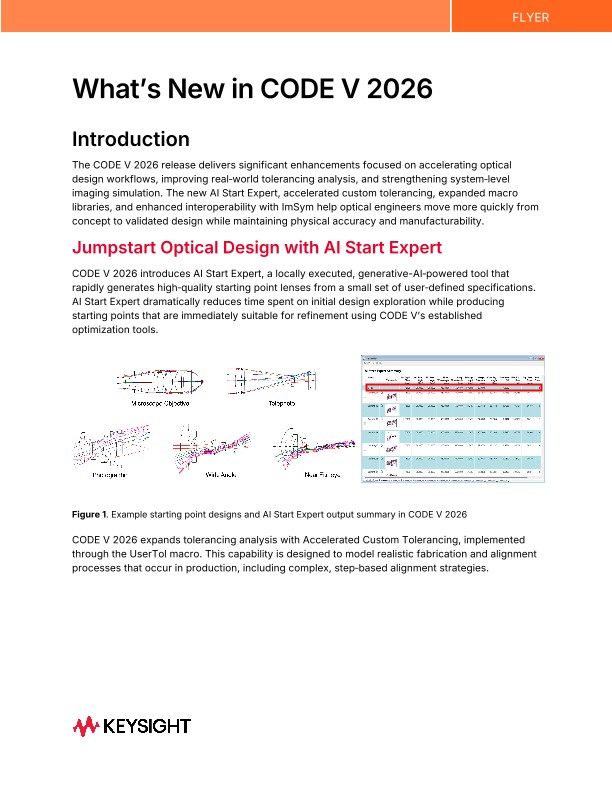
The new AI Start Expert generates high‑quality starting lens designs from minimal user inputs such as field of view, focal length, and aperture. It supports applications including camera lenses, telephoto systems, microscope objectives, and projectors. Running entirely on‑premise, it reduces early-stage design time and provides immediately usable starting points for optimization.
Accelerated Custom Tolerancing for Real‑World Manufacturing
CODE V 2026 enhances tolerancing with parallelized Monte Carlo analysis and support for multi‑step alignment processes. Engineers can define custom performance metrics, evaluate yield with uncertainty, and analyze pass/fail performance across multiple criteria. These capabilities improve confidence in manufacturability and alignment robustness.
Expanded Macro Library for Faster Analysis
New and updated macros streamline tasks such as ghost analysis, wave aberration visualization, and material labeling in lens drawings. Additional tools support metalens layout export (including OASIS format) and automated PSF grid sizing. These features enable faster iteration and deeper insight into optical performance and stray light behavior.
System‑Level Imaging with Lens Performance Data Export
Lens Performance Data (LPD) export allows seamless integration with ImSym and other tools without exposing proprietary lens designs. Engineers can simulate full imaging systems, including aberrations, diffraction, stray light, sensor effects, and image processing—supporting use case validation and AI training workflows.
New Example Models for Faster Adoption
An expanded model library includes new examples for AI workflows, tolerancing, wave aberration analysis, and applications such as automotive HUDs, helping users quickly apply new features.
Summary
CODE V 2026 combines AI‑assisted design, advanced tolerancing, automation, and system‑level simulation to help optical engineers move from concept to validated design more efficiently while maintaining physical accuracy and manufacturability.