
What’s New in LightTools 2026
散页
LightTools 2026: Faster Simulation, Advanced Visualization, and Expanded Optical Modeling
LightTools 2026 introduces major enhancements to optical modeling, ray tracing performance, stray‑light analysis, and emerging applications such as AR waveguides and meta‑optics. The release focuses on improving simulation speed, visualization quality, and interoperability with CAD and photonic design tools.
VisionSym Integration for Real‑Time Visualization
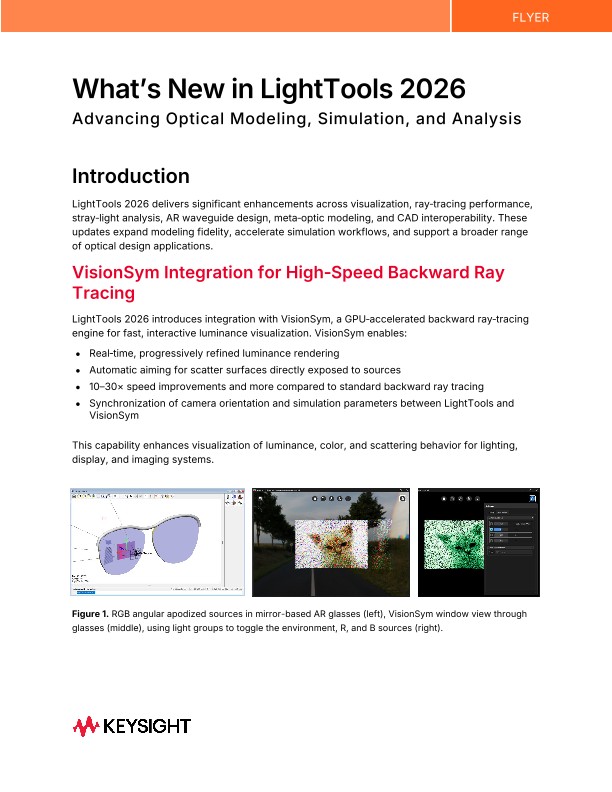
New integration with VisionSym adds GPU‑accelerated backward ray tracing for fast, interactive luminance visualization. Engineers can view progressively refined results in real time, with automatic aiming for scatter surfaces and synchronized simulation settings. This delivers 10–30× faster rendering compared to traditional methods, improving analysis of lighting, display, and imaging systems.
GPU‑Accelerated Forward Ray Tracing
LightTools 2026 introduces GPU acceleration for forward ray tracing, achieving performance gains from 10× to over 50× depending on the model. It supports a wide range of sources, materials, scattering models, and receivers, significantly reducing simulation times for complex optical systems.
Enhanced Stray Light Analysis
New tools improve repeatability and efficiency in stray light workflows. Users can import/export ray paths for reproducibility, limit rays per path to reduce memory usage, and analyze filtered datasets more quickly. Updates to surface grouping and the Ray Path Analyzer simplify handling complex CAD geometries and reduce analysis complexity.
AR Waveguide Designer Improvements
The AR Waveguide Designer now includes automated setup for couplers and waveguides, K‑space visualization, support for spatially varying gratings using RSoft data, and tools for uniformity and eyebox analysis. Integrated stray light identification and display visualization streamline AR system development.
Meta‑Optic Lens Modeling
New meta‑optic capabilities enable modeling of advanced metasurfaces, including phase and transmission analysis, compatibility with RSoft meta‑atom libraries, and polarization‑dependent behavior. This supports compact, high‑performance optical designs for imaging and display applications.
Expanded CAD Interoperability
Support for NX, Creo, and Rhino formats improves CAD integration. The updated import workflow preserves assembly hierarchy, naming, and color, enables surface‑level optical property assignment, and includes a beta feature for synchronized CAD updates.
Summary
LightTools 2026 enhances simulation speed, visualization, and modeling flexibility, enabling engineers to analyze more complex systems faster while supporting next‑generation applications such as AR waveguides and meta‑optics.