
What’s New in RSoft Photonic Device Tools 2026
散页
RSoft 2026 introduces advanced capabilities for the simulation and design of photonic devices, reinforcing its role as a comprehensive suite for photonics and optoelectronics workflows. This release delivers powerful new products, enhanced performance, and expanded integration to support the development of silicon photonics, Photonic Integrated Circuits (PICs), and diffractive optical elements.
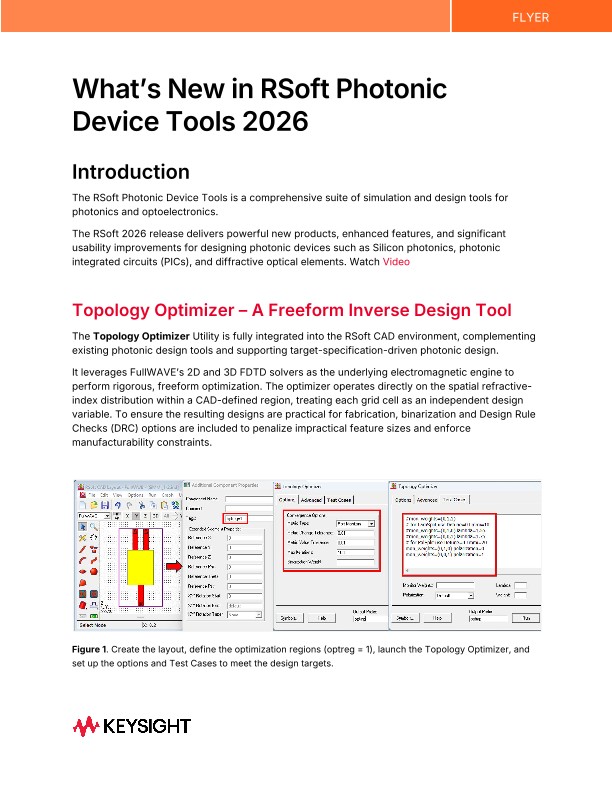
A key innovation is the Topology Optimizer, a freeform inverse‑design tool embedded within the RSoft CAD environment. It enables target‑specification‑driven photonic design by automatically generating optimal material layouts or geometries to achieve defined performance objectives, eliminating the need for predefined structures and accelerating design exploration.
RSoft 2026 also strengthens workflow integration through enhancements to the Custom PDK Utility, enabling seamless connectivity between RSoft Photonic Device Compiler and Keysight ADS Photonic Designer. This integration supports all passive, S‑matrix‑based components and allows automated generation of model cells — including simulation data, layout, and symbols — for use in custom device libraries, IP libraries, and foundry PDKs.
Significant performance improvements are delivered through enhanced GPU‑accelerated FullWAVE FDTD. The release reduces initialization time and minimizes pre‑ and post‑processing overhead, enabling up to 3× speedup for dispersive simulations. GPU acceleration is now extended to support both 3D and 2D FDTD simulations, further improving design efficiency.
The BSDF‑Generation utility has been expanded to better capture real optical behavior and bridge wave and ray optics. New capabilities include a Resume function for automatically recovering incomplete simulations, an expanded BSDF Viewer for visualizing transmission and phase across multiple parameters, and bidirectional BSDF Converter Utilities for open‑format data exchange and integration with external workflows or measurement‑based datasets.
With these advancements, RSoft 2026 enables engineers to design higher‑performance photonic components, accelerate simulation workflows, and integrate seamlessly across photonic design environments.