
Velocity 4900 Automation Switch Series
技术资料
The Keysight Velocity 4900 Automation Switch Series provides Layer 1 switching for test lab connectivity and automation. The series helps organizations manage physical connections and network topologies, share lab equipment, and automate testbed setup. Designed for 25G and 100G test environments, the switches combine a scalable architecture with flexible port configurations and programmatic control. This data sheet describes the series’ capabilities, compares the Velocity 4902 and 4906 models, and outlines their technical specifications and role within the broader Velocity Automation Portfolio.
Test labs must support changing network speeds, interface types, and testing requirements while controlling equipment, energy, and labor costs. The Velocity 4900 Series addresses these needs by enabling teams to pool resources and configure connections without repeatedly changing physical cabling. Automated connection changes reduce setup time and support repeatable test scenarios. The switches can serve dedicated performance test labs or consolidated lab environments where teams share access to equipment and infrastructure.
The series uses a transparent, protocol-agnostic, non-blocking Layer 1 matrix for functional and performance testing. Unlike conventional Ethernet switches, Layer 1 forwarding does not require MAC learning, routing protocols, packet inspection, or packet queues. This architecture avoids output-buffer contention and packet loss caused by switch congestion. Ultra-low, deterministic latency and low jitter help preserve test fidelity, allowing teams to connect devices and test equipment while minimizing the switching infrastructure’s effect on measurements.
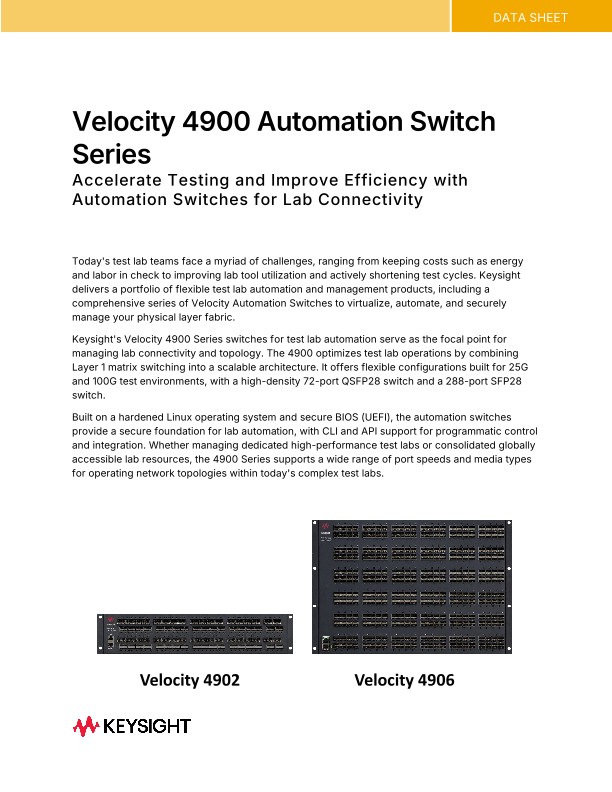
The Velocity 4902 is a 2RU switch with 72 QSFP28 ports, supporting up to 288 ports through breakout configurations. Built for 25G and 100G test environments, it supports multiple speeds from 100 Mb/s through 100 Gb/s. The Velocity 4906 is a 6RU switch with 288 SFP28 ports, designed for high-density 25G environments. Both models support per-port configuration and an architecture that scales to thousands of ports, allowing organizations to expand connectivity as lab requirements grow.
Flexible speed and media selection enables the switches to support varied equipment and test topologies. The data sheet lists single-mode and multimode fiber, direct attach cables, active optical cables, active electrical cables, coaxial connections, and HDMI among the supported media options. Listed applications include Ethernet, Fibre Channel, InfiniBand, CPRI, HDMI, SDI, and SAS/SATA. Teams can configure individual ports to match the requirements of connected devices and test scenarios.
Diagnostic and connectivity capabilities include port tapping, traffic replication, media conversion, multicasting, and aggregation. Any-to-any connections and one-to-many replication support flexible test arrangements, while port tapping enables monitoring and troubleshooting. CLI and API support provide programmatic control and integration with automated workflows. A hardened Linux operating system and secure BIOS based on UEFI provide the platform’s security foundation. Both models include redundant, hot-swappable power supplies and fans, with front-to-rear airflow.
The model comparison presents port counts, form factors, speed ranges, media types, supported applications, management interfaces, physical dimensions, and power information. These details help lab planners assess model suitability, rack requirements, and integration needs.
The data sheet also places the 4900 Series within the Velocity Automation Portfolio, which supports lab resource management, test creation, connectivity, and automation services. It introduces the complementary Velocity HS Series for requirements that include Ethernet speeds up to 400G, rate conversion, and aggregation. Together, these portfolio options address different connectivity and automation needs across enterprise, network equipment manufacturer, and service provider test labs.