
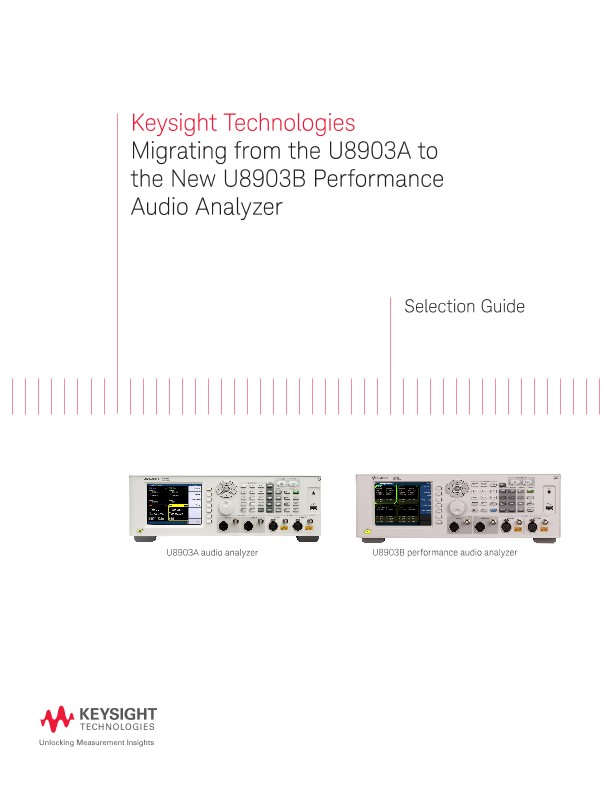
Migrating from the U8903A to the new enhanced U8903B Performance Audio Analyzer
技术概述
Keysight Technologies
Migrating from the U8903A to
the New U8903B Performance
Audio Analyzer
Selection Guide
Introduction
The Keysight Technologies, Inc. U8903B performance audio analyzer was introduced in 2014 as the successor model of the U8903A audio analyzer. Besides providing analog and digital audio generation and analysis functions, the U8903B has been enhanced with a new graphical user interface (GUI), features and improved measurement performance. This migration guide will compare these two audio analyzers and also explain the U8903B’s added features and performance.
Physical Appearance and Dimension
Both the U8903A and U8903B are equipped with generator and analyzer channels. The standard configuration instrument comes with two generator channels and two analyzer channels at the front panel, as shown in Figure 1. On the physical dimension, both models have the same width and height, so the U8903B can replace the U8903A on a test rack system. However, the new U8903B is 20 mm longer in depth.
The look and feel of the U8903B and U8903A’s front panels are very similar, as illustrated in Figure 2. The display, numerical keypad and function keys positions are the same for both models. However in the new U803B, there are slight layout changes on the Function/Mode, Graph and Systems keys.
As for the rear panel (Figure 3), the U8903B has new features such as optional analog analyzers which can be configured up to maximum of six additional channels. The U8903B’s rear panel also contains the new and optional AUX and monitor channels. Lastly, the 25-pin D-SUB connectors for the U8903B have been changed to the female-type, whereas the connector in the U8903A remains as male-type.
There are also changes to the U8903B’s graphic user interface (GUI), as illustrated in Figure 4. The U8903B audio analyzer is able to perform and display four real time measurement functions on its display. The U8903A, in comparison, only displays two measurement functions at a time. Both audio analyzers display the generator and analyzer channel settings at bottom of the GUI display.
New Features and Functions in the U8903B Performance Audio Analyzer
As mentioned earlier, the U8903B has new features and improved measurement performance. The features and performance comparison between the U8903A and the U8903B are shown in the table below.
Superb low residual distortion on eight channels
The new design architecture of the U8903B has reduced the residual distortion significantly to < -108 dB (< -110 dB typical), compared to only < -101 dB for the U8903A. The low residual distortion specification enables engineers and technicians to measure and analyze performance audio devices.
Unlike the U8903A, which only has two analog analyzer channels, the U8903B can be configured with up to eight analog analyzer channels. The additional channels are located at the rear panel, as shown in Figure 3. The < -108 dB residual distortion performance is available for up to eight channels simultaneously (see Figure 5).
Expanded 1.5 MHz analysis bandwidth
The U8903B has a slightly reduced analog input bandwidth compared to the U8903A. The U8903A analog analyzer frequency range starts from 10 Hz to 100 kHz, whereas the U8903B can only measure up 96 kHz due to the internal design architecture. However, the U8903B has a purchasable wide bandwidth option which expands the bandwidth to 1.5 MHz. This option is only available for the two front panel analog analyzer channels.
Voice quality with PESQ and POLQA
Another new feature in the U8903B is the voice quality test. There are two test configurations available in the U8903B. First is the perceptual evaluation of speech quality (PESQ) as recommended in ITU-T P.862. There is also the perceptual objective listening quality assessment (POLQA), according to ITU-T Rec. P.863 [2011]. POLQA is the next-generation mobile voice quality testing standard for HD-Voice, VoIP, 3G and 4G/ LTE. By comparing the reference signal with a degraded signal, the PESQ and POLQA tests will provide a mean opinion score (MOS) measurement result, from a scale of 1 to 5. Figure 6 provides an overview of a VOIP voice quality test set up using the U8903B.