
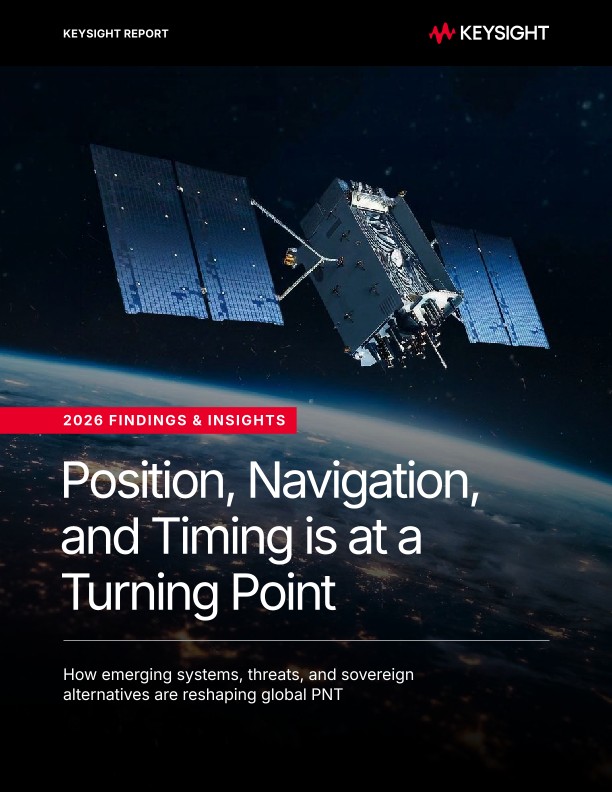
The Keysight PNT Report 2026
报告
Position, navigation, and timing (PNT) technologies support critical systems across transportation, communications, energy, defense, automotive, aviation, and space exploration. As reliance on PNT grows, the technology landscape is becoming more complex. New sources of PNT are emerging, threats such as jamming and spoofing are evolving, and governments are investing in greater resilience and sovereignty. At the same time, advances in autonomy, low Earth orbit (LEO), lunar exploration, and next-generation communications are creating new requirements for PNT performance and assurance.
The Keysight PNT Report 2026 examines the market, technology, and industry developments shaping this changing landscape. It explores how the PNT value chain is evolving as organizations combine traditional global navigation satellite systems (GNSS) with alternative and complementary technologies. These include LEO PNT, inertial sensors, terrestrial signals, multi-sensor positioning, and new regional and sovereign navigation systems.
The report looks at momentum across medium Earth orbit (MEO) and LEO systems, including modernization of established GNSS constellations and investment in new PNT services. It also examines national and regional initiatives designed to reduce dependence on individual GNSS constellations and strengthen resilience. Developments across Europe, Asia, the United States, and other regions demonstrate a broader movement toward layered PNT architectures that combine satellite, terrestrial, and sensor-based sources.
Resilience is another central theme. GNSS receivers increasingly operate in environments affected by jamming, spoofing, meaconing, signal blockage, multipath effects, cyber threats, and other forms of interference. The report examines how these threats are evolving across terrestrial, space, cyber, timing, and multi-domain environments. It also considers mitigation technologies such as controlled reception pattern antennas (CRPAs), multi-frequency and multi-constellation receivers, alternative PNT sources, signal authentication, and sensor fusion.
These developments affect industries differently. In aviation, operators and manufacturers need to improve positioning accuracy while reducing vulnerability to GNSS interference. Automotive developers must combine GNSS with cameras, radar, lidar, inertial measurement units, and other sensors to support advanced driver assistance systems and autonomous driving. Smartphone developers face increasing expectations for accurate positioning within constrained device designs. Meanwhile, expanding drone and low-altitude aviation markets are creating new requirements for autonomous operation, traffic management, and positioning resilience.
Looking further ahead, the report identifies eight emerging technology areas that could shape PNT over the next several years. These include artificial intelligence and machine learning for hybrid positioning, precise orbit determination and collision avoidance in LEO, dedicated PNT services for the Moon and Mars, chip-scale atomic clocks for timing resilience, advanced CRPA technology, quantum inertial navigation, satellite and private 5G positioning, and the integration of PNT with future 6G sensing and communications systems.
The report also examines what these changes mean for PNT testing and assurance. As systems incorporate more signals, sensors, frequency bands, and sources of positioning data, developers need to validate performance under increasingly complex real-world conditions. Greater test realism can help teams evaluate resilience to interference, environmental effects, dynamic motion, and combinations of threats before deployment.
Keysight is responding to these requirements with capabilities for realistic laboratory simulation, LEO PNT testing, software-based testing, CRPA validation, anechoic chamber testing, and simulation of emerging signals. The report explores how technologies such as PNT X, SimXTRACT, SimIQ, and signal-specific simulation capabilities can help developers introduce realistic conditions earlier in the development process and evaluate increasingly complex PNT architectures.
Together, these trends point toward a PNT ecosystem that is more layered, interconnected, and resilient. GNSS remains foundational, but future systems will increasingly combine multiple sources of positioning and timing information. For developers, system integrators, and technology leaders, understanding these changes — and being able to test them realistically — will be critical to developing the next generation of trusted PNT systems.