
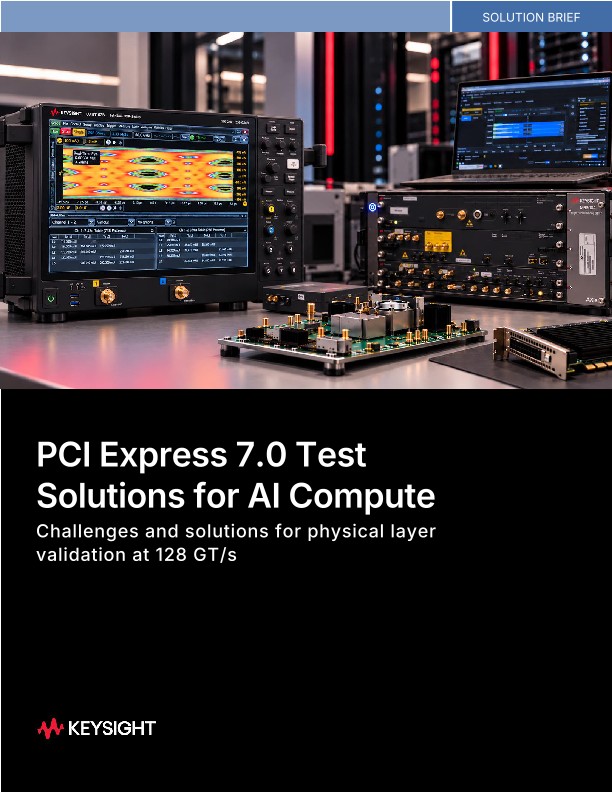
PCI Express 7.0 Test Solutions for AI Compute
解决方案概述
Artificial intelligence (AI) infrastructure depends on the efficient movement of data between processors, accelerators, memory resources, and high-speed fabrics. As AI models grow in size and complexity, the performance benefits of additional compute resources increasingly depend on the bandwidth and reliability of interconnect technologies. The PCI Express®️ (PCIe®️) 7.0 standard plays a critical role in this environment by providing the high-speed connectivity that links devices throughout modern AI compute systems.
PCIe 7.0 doubles the data rate of the previous generation, increasing performance to 128 GT/s per lane while continuing to use PAM4 signaling. These higher signaling speeds support the data movement requirements of AI scale-up architectures, where tightly coupled processors, GPUs, memory systems, and accelerators must exchange large volumes of information with minimal latency. However, the transition to 128 GT/s significantly reduces available electrical margin and increases the complexity of physical-layer validation.
At PCIe 7.0 data rates, engineering teams face challenges that extend beyond traditional compliance testing. PAM4 signaling introduces three eye openings instead of the single eye used in NRZ signaling, making measurements more sensitive to noise, distortion, jitter, channel loss, and test-system limitations. Validation engineers must accurately separate device-under-test performance from measurement-system effects while ensuring that results remain consistent and repeatable across multiple operating conditions.
A complete PCIe 7.0 validation strategy requires evaluation of both transmitter and receiver behavior. Transmitter testing characterizes signal quality and compares measured electrical parameters against specification-defined requirements. These measurements include signal-to-noise and distortion ratio (SNDR), relative level mismatch (RLM), jitter analysis, reference-clock characterization, and other parameters required by the PCIe 7.0 Base Specification. Beyond simple pass/fail compliance results, margin measurements help engineers understand design robustness and identify potential interoperability risks before deployment.
Receiver validation presents a different set of challenges. Rather than evaluating a nominal input signal, receiver testing requires the creation of carefully calibrated stressed signals that emulate real-world channel conditions. Engineers must establish controlled combinations of channel loss, equalization, interference, jitter, and other impairments while maintaining precise calibration at multiple test points. As signaling speeds increase, generating and verifying these conditions becomes a significant measurement challenge in its own right.
The complexity of PCIe 7.0 receiver testing is amplified by the number of interacting parameters that influence system behavior. Launch amplitude, transmitter equalization settings, reference-receiver processing, channel characteristics, clock recovery algorithms, and added impairments must all be calibrated and verified to ensure meaningful results. These requirements can significantly increase test effort and introduce opportunities for inconsistency when performed using manual methods.
To address these challenges, automated validation workflows play an increasingly important role. Automation helps standardize setup, calibration, measurement execution, report generation, and result analysis while reducing manual variation between operators and test environments. Automated workflows can also improve repeatability and accelerate the validation process by guiding engineers through complex compliance and characterization procedures.
This paper examines the key challenges associated with PCIe 7.0 transmitter and receiver validation at 128 GT/s and explores practical approaches for overcoming them. It discusses the measurement requirements introduced by PAM4 signaling, the importance of compensation techniques such as de-embedding and equalization, and the need for accurate calibration of stressed receiver conditions. The paper also outlines methodologies for transmitter characterization, receiver pathfinding, margin analysis, and compliance automation.
In addition, the paper highlights how integrated test solutions combining high-performance oscilloscopes, bit error ratio testers (BERTs), analysis software, and automated validation workflows can help engineering teams address the increasing complexity of next-generation interconnect standards. By streamlining measurement tasks and improving consistency, these approaches allow teams to focus more time on identifying design limitations and investigating interoperability concerns.
As PCIe continues to evolve to support AI compute infrastructure, validation requirements will become increasingly demanding. Success depends on the ability to accurately characterize both transmitted and received signals, understand available operating margin, and efficiently execute repeatable test procedures across multiple device types and operating conditions. Scalable validation methodologies help engineering organizations accelerate development, reduce risk, and build confidence that PCIe 7.0 implementations will deliver the performance and reliability required for future AI systems.