
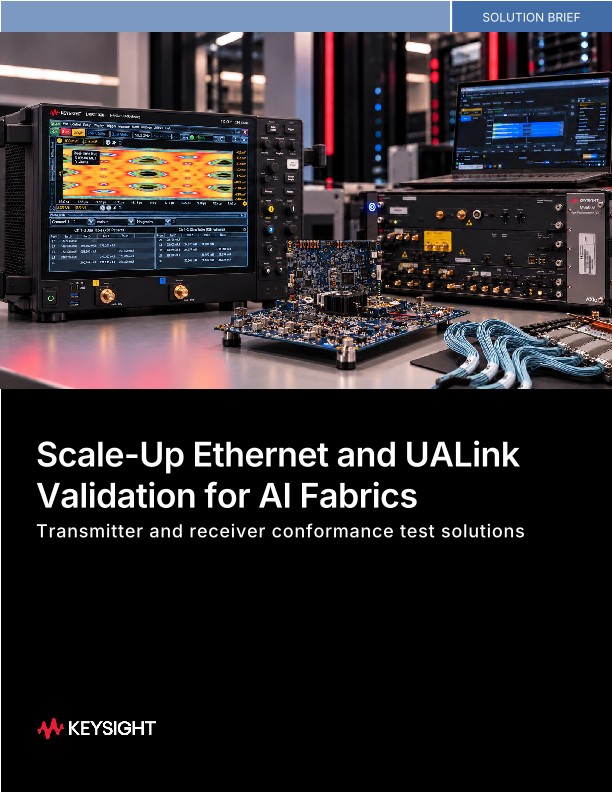
Scale-Up Ethernet and UALink Validation for AI Fabrics
解决方案概述
As artificial intelligence infrastructure scales to support larger models and increasingly distributed compute architectures, the communication fabric connecting accelerators, processors, switches, and memory becomes a critical determinant of overall system performance. While advances in compute density continue to increase processing capability, the ability to move data efficiently throughout the system increasingly defines how effectively those resources can be utilized. Bandwidth, latency, reliability, and interoperability all play essential roles in ensuring that AI systems operate at their intended performance levels.
To address these growing demands, the industry is advancing a new generation of high-speed scale-up fabrics. Electrical Ethernet, Ultra Accelerator Link (UALink), Ultra Ethernet, and Ethernet for Scale-Up Networking (ESUN) represent different approaches to enabling communication within AI infrastructure. Electrical Ethernet provides the physical-layer foundation for 800G and 1.6T systems through 200 Gb/s-per-lane interfaces across chip-to-chip, chip-to-module, backplane, and copper-cable connections. UALink builds upon Ethernet-based physical-layer technology to create a low-latency accelerator fabric optimized for scale-up AI architectures. Higher-level initiatives such as Ultra Ethernet and ESUN seek to further optimize Ethernet-based networking for AI and high-performance computing workloads.
Although these technologies differ in architecture, protocol implementation, and deployment objectives, they share common physical-layer challenges. As signaling rates advance to 200 Gb/s per lane using 106.25 GBd PAM4 signaling and beyond, available electrical margin continues to shrink. Designers must account for channel loss, reflections, crosstalk, jitter, noise, equalization behavior, and receiver sensitivity to ensure reliable communication across increasingly demanding operating conditions.
Successful validation requires more than traditional eye-diagram measurements. Engineering teams must establish confidence across multiple stages of the validation process, including channel characterization, transmitter compliance, receiver tolerance testing, and system-level interoperability analysis. Each stage contributes unique insight into overall link robustness and helps identify potential limitations before deployment.
Channel characterization serves as the foundation for understanding link behavior. Physical channels introduce impairments through packages, printed circuit boards, connectors, backplanes, and cables that can significantly affect signal quality at modern signaling speeds. Accurate characterization through S-parameter measurements, insertion-loss analysis, effective return-loss evaluation, and Channel Operating Margin (COM) calculations helps engineers establish whether a channel can support reliable operation and provides context for interpreting transmitter and receiver results.
Transmitter validation focuses on the quality of the signal launched into the channel. PAM4 signaling carries two bits per symbol using four signal levels, enabling higher throughput but reducing available voltage margin compared to traditional non-return-to-zero (NRZ) signaling. Compliance testing therefore requires sophisticated analysis techniques including reference-receiver emulation, clock recovery, equalization, jitter characterization, signal-to-noise-and-distortion ratio (SNDR) measurements, return-loss analysis, and amplitude linearity evaluation. Beyond demonstrating compliance, margin analysis helps engineers quantify design robustness and identify potential interoperability concerns.
Receiver validation introduces additional complexity because devices must be evaluated under carefully calibrated stressed conditions that replicate real-world operating environments. Engineers must create repeatable combinations of noise, interference, jitter, channel loss, and transmitter impairments while ensuring compliance with standard-defined test methodologies. Stressed receiver testing provides insight into receiver tolerance and operating margin while helping teams assess how implementations may behave under challenging deployment conditions.
The paper examines transmitter and receiver validation methodologies for both IEEE 802.3dj Electrical Ethernet and UALink 200G interfaces. While UALink leverages Ethernet-derived physical-layer technologies, its focus on accelerator scale-up architectures introduces unique compliance requirements, calibration procedures, and interoperability considerations. Understanding both the similarities and differences between these validation approaches can help engineering organizations streamline development and accelerate deployment.
Beyond individual device validation, the paper highlights the importance of system-level verification. Compliance testing establishes confidence that individual components meet specification requirements, but successful AI infrastructure depends on reliable operation across complete systems. Link training, forward error correction, protocol functionality, interoperability, fabric bring-up, and traffic validation all contribute to overall system reliability. Correlating these higher-layer activities with physical-layer measurements provides a more complete understanding of system behavior and supports more effective root-cause analysis when issues arise.
The paper also explores how automation improves repeatability, accelerates test execution, and reduces measurement variability across projects and engineering teams. Automated workflows for calibration, compliance testing, receiver stress generation, and reporting help organizations maintain consistency while adapting to increasingly complex validation requirements.
As AI infrastructure continues to evolve toward larger accelerator clusters and higher-bandwidth fabrics, robust validation methodologies become increasingly important. By combining channel characterization, transmitter compliance testing, receiver stress validation, and system-level interoperability assessment, engineering teams can build confidence in Ethernet and UALink implementations, reduce integration risk, and support reliable operation across next-generation AI scale-up environments.