


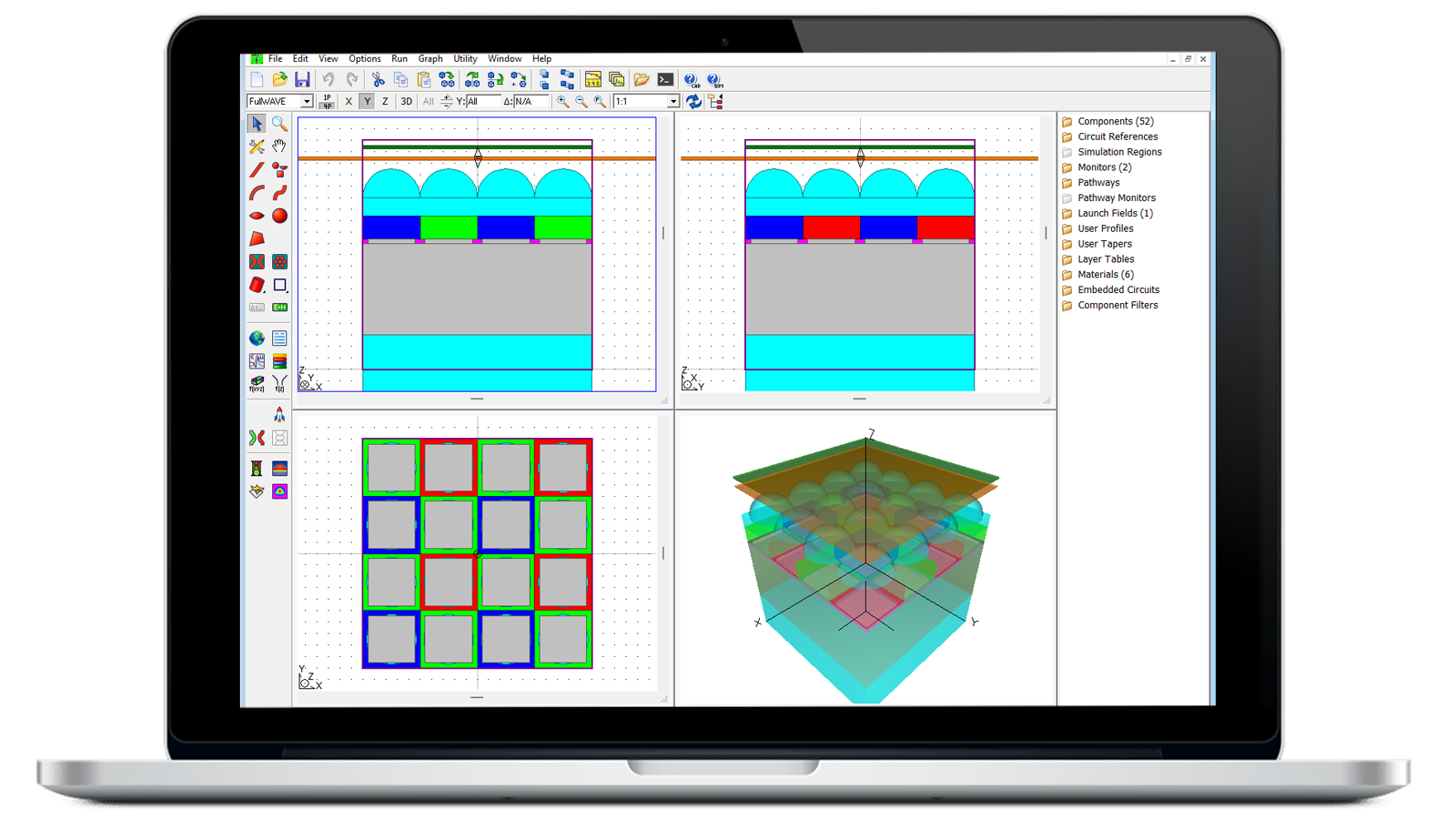
Why Use RSoft FullWAVE FDTD
RSoft FullWAVE, Keysight’s finite-difference time-domain (FDTD) simulation software, enables full-vector simulations of photonic structures, including integrated and fiber-optic waveguide devices, as well as circuits and nanophotonic devices such as photonic crystals. Gain dynamic insights into scattering, transmission, reflection, absorption, and more.
Use RSoft FullWAVE FDTD for
- Modeling light propagation, reflection, scattering, and diffraction in complex structures
- Analyzing photonic devices in which light travels in multiple directions
- Simulating resonant and wavelength-scale nanophotonic structure
- Evaluating electromagnetic field distributions and device response over time
- Studying grating couplers, resonators, and photonic crystal devices
- Modeling image-sensor pixels, micro-LEDs, and other high-resolution structures
- Validating designs when simplified propagation assumptions are not sufficient

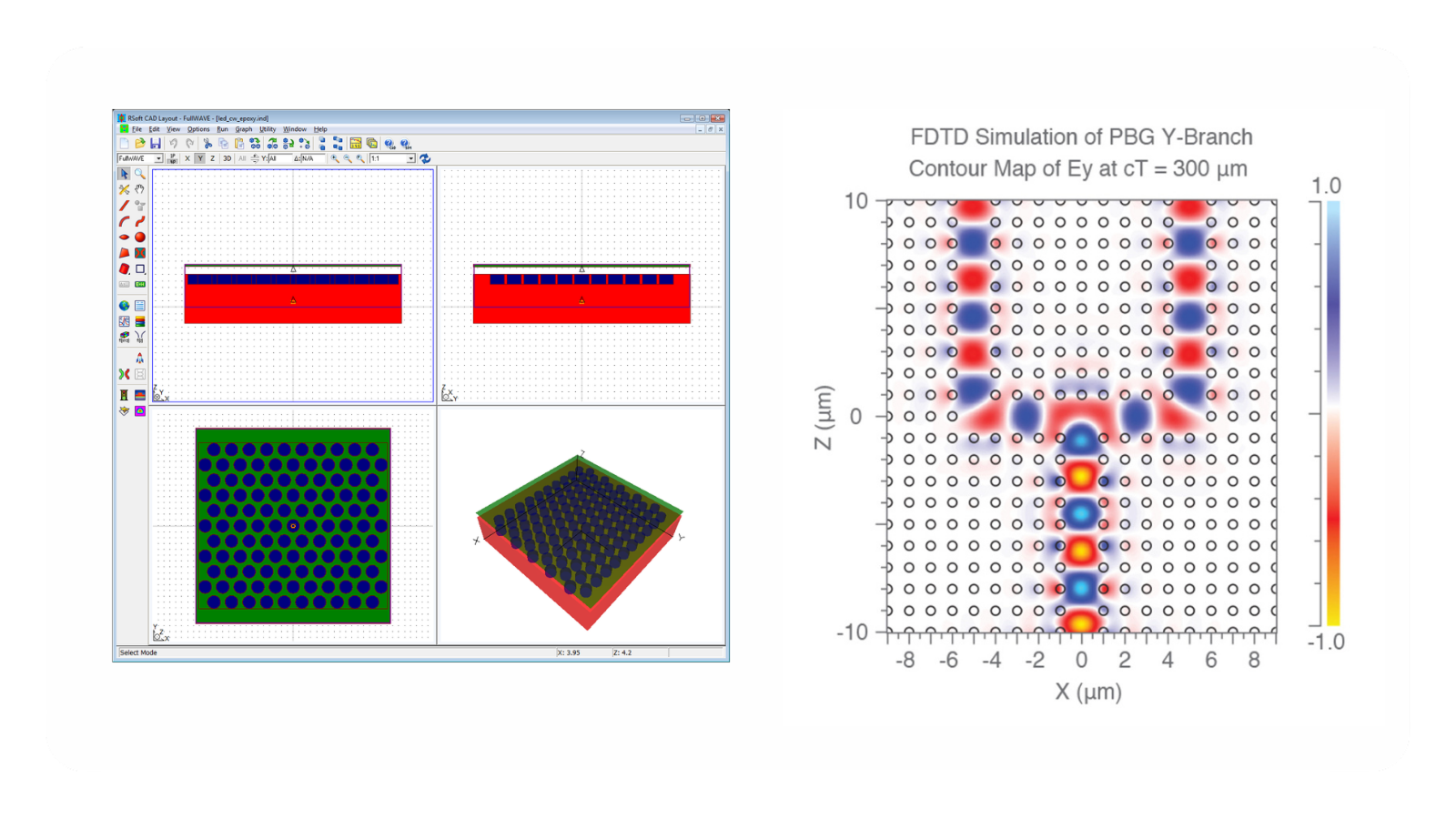
 Rigorous Time-Domain Electromagnetic SimulationModel the propagation of light through complex photonic structures by solving electromagnetic behavior over space and time.
 Flexible Material and Device ModelingAnalyze structures containing dielectric, dispersive, anisotropic, nonlinear, metallic, or other application-specific materials.
 Detailed Field and Power AnalysisEvaluate electromagnetic fields, transmission, reflection, scattering, resonances, and power flow throughout the simulated structure.
 High-Performance ComputationRun computationally intensive FDTD models using supported parallel-processing and GPU-accelerated configurations.
Key Outcomes

Capture reflections, resonances, scattering, and multidirectional propagation that simpler methods may not fully represent.

Examine field behavior and optical response before committing to a physical prototype.

Visualize where light is reflected, scattered, absorbed, confined, or coupled within a device.

Apply parallel and GPU computing to reduce calculation time for supported high-resolution models.
RSoft BeamPROP BPM
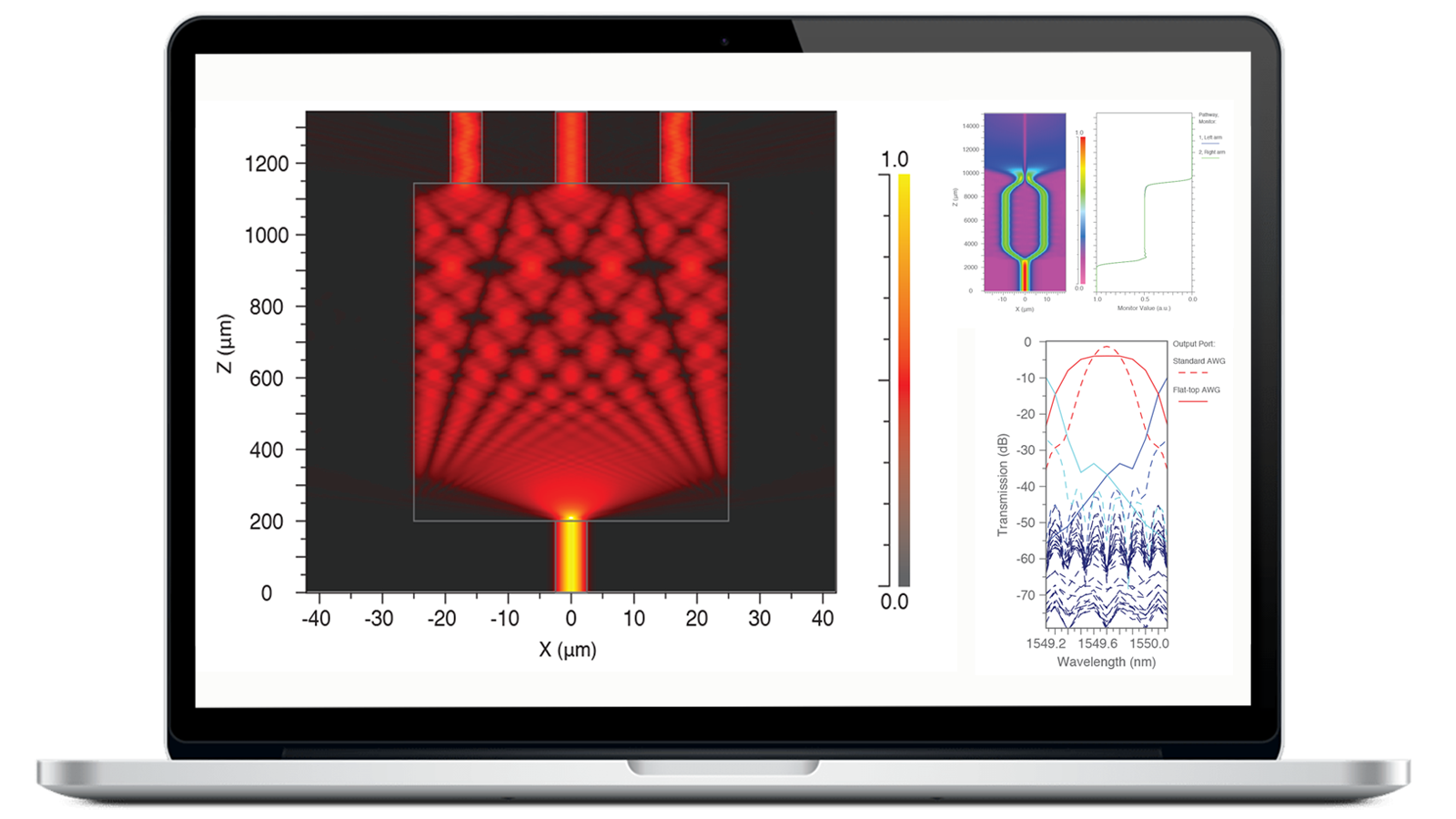
Use industry-leading RSoft BeamPROP BPM design software to rapidly and accurately design and simulate integrated and fiber-optic waveguide devices and circuits.
RSoft DiffractMOD RCWA
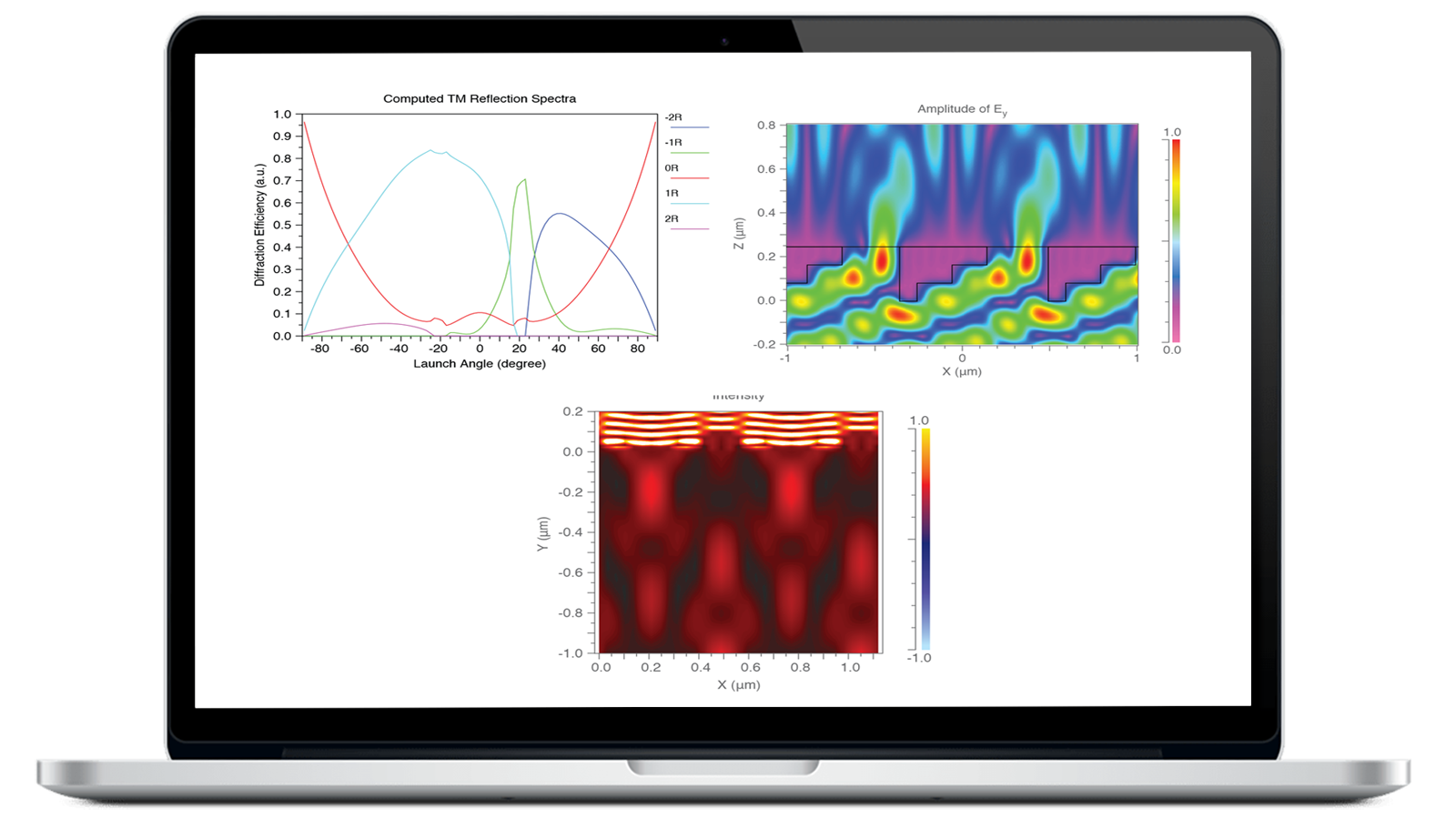
Use DiffractMOD RCWA design tool for diffractive optical structures, subwavelength periodic structures, photonic bandgap crystals, and more.
RSoft BandSOLVE PWE
Automate and simplify photonic band structure for photonic crystal devices with RSoft BandSOLVE plane wave expansion design tool.
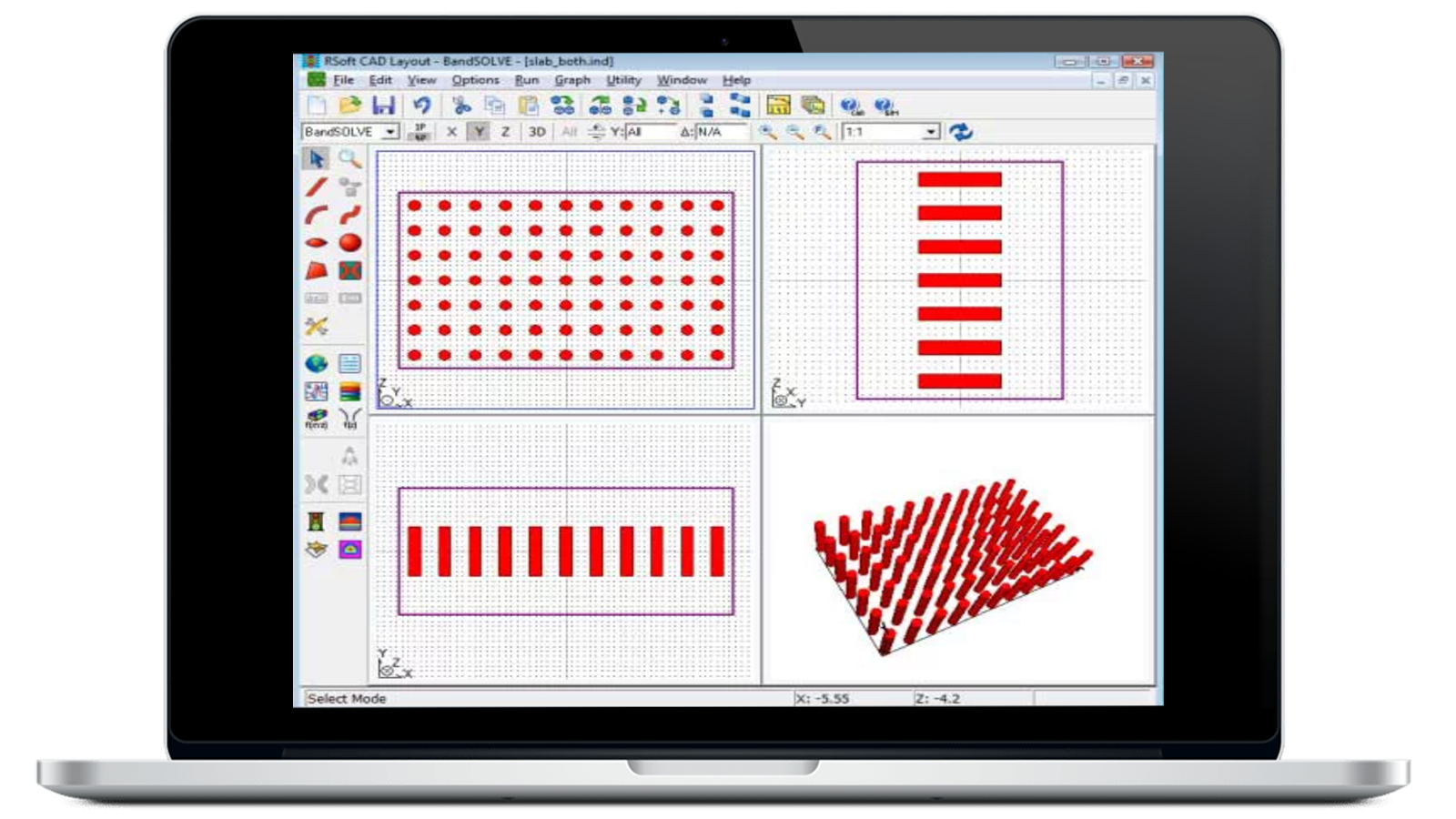
RSoft CAD Environment
The RSoft CAD Environment is the core program of the RSoft photonic device tools. Design waveguide devices, optical circuits, and other photonic devices.
Resources to Get You Started
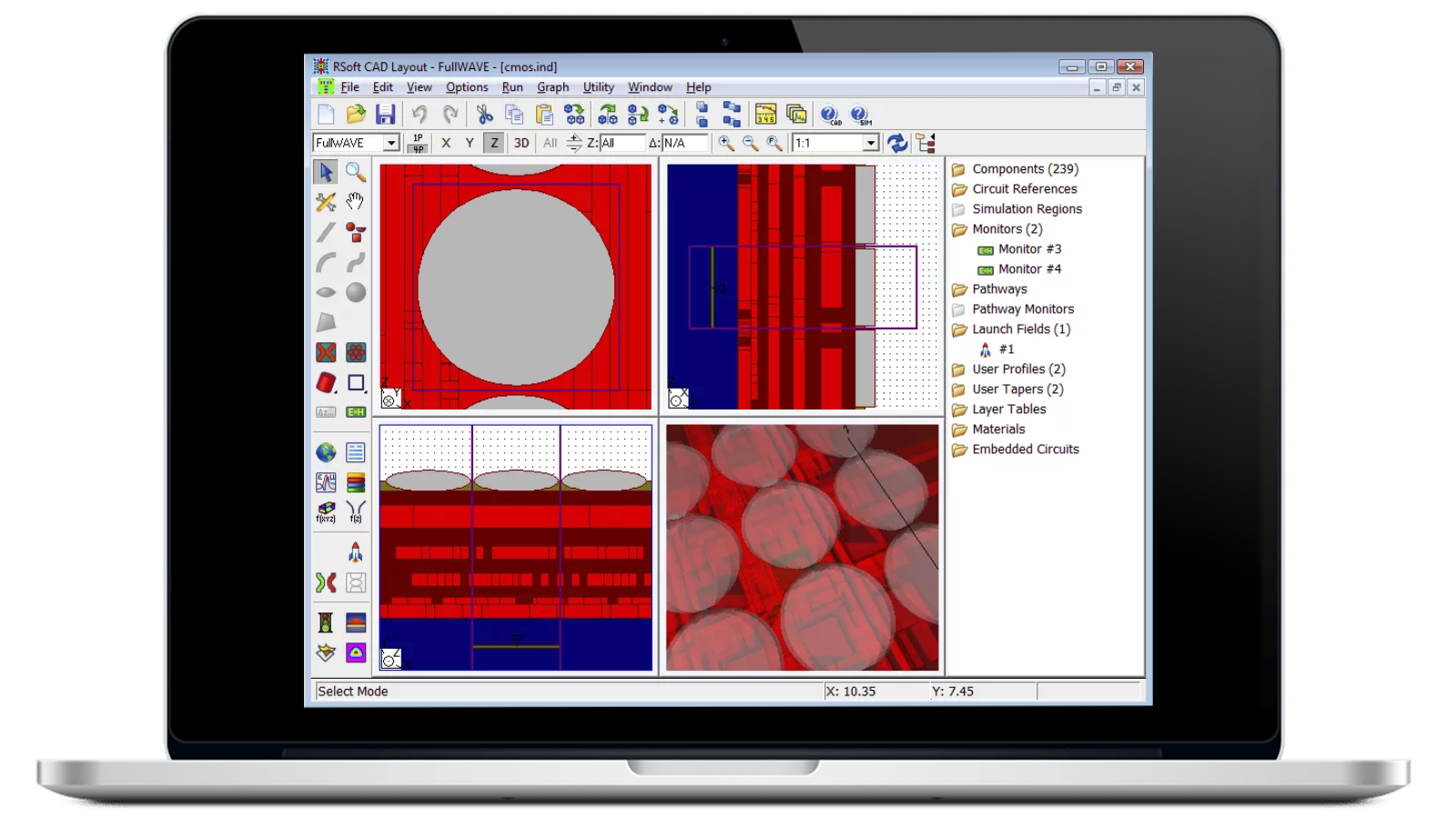
Finite-difference time-domain (FDTD) simulation is one of the most rigorous methods for modeling photonic devices, but large, high-resolution models can require significant computational resources. This application note demonstrates how GPU acceleration can dramatically reduce simulation times while maintaining the accuracy required for photonic design and analysis. Learn how engineers are applying GPU-accelerated FDTD simulation to micro-LEDs, CMOS image sensors, grating couplers, and other computationally intensive photonic applications.


应用文章
Creating a Pulse Train using Custom Time Envelopes

应用文章
OLED-Based Display
应用文章
Plasmon Nano Probe for Semiconducting Nanodevices and Bio/Chemical Sensors
应用文章
Simulate Twisted Nematic (TN) Liquid Crystal Cell
应用文章
Mie Scattering from a 3D Dielectric Sphere
应用文章
Dielectric THz Metalens Design
应用文章
Designing LIDAR on a Chip
应用文章
Reflective Multimode Interference Coupler
应用文章
Modeling a Ring Resonator
应用文章
Using Q-Finder to Automate Cavity Mode and Q Calculations
应用文章
Improving Solar Cell Efficiency with Surface Plasmons
Have Questions? We've Got Answers
Finite-Difference Time-Domain (FDTD) simulation is a numerical electromagnetic technique that solves Maxwell's equations to model the propagation of light through photonic structures. FullWAVE FDTD uses this approach for photonic device simulation and analysis.
FDTD is typically used when light can propagate in multiple directions and effects such as scattering, diffraction, and reflections must be modeled rigorously. BPM is often more efficient for structures where light primarily propagates in one direction.
FullWAVE FDTD can be used for photonic structures such as ring resonators, grating couplers, photonic crystal devices, nanophotonic components, CMOS image sensors, and micro-LEDs.
Yes. FullWAVE FDTD supports GPU acceleration and multi-GPU computation using NVIDIA GPU technology. Published test data shows up to 91x computational improvement in certain simulation scenarios.
FullWAVE FDTD is part of the RSoft Photonic Device Tools portfolio and can participate in broader photonic design workflows involving device optimization, compact model generation, and photonic circuit development.