Integrated Sensing and Communication (ISAC) Testing in the Lab
样机
ISAC combines wireless communication and sensing capabilities. The Third-Generation Partnership Project (3GPP) Release 19 addresses a practical engineering challenge: reproducing target behavior and background channel conditions without relying on resource-intensive field testing.
Our expert walks through how to test ISAC algorithms, devices, and base stations in the lab with a workflow for modeling wireless sensing scenarios, emulating moving targets in real-time, and evaluating target detection and tracking with real test equipment.
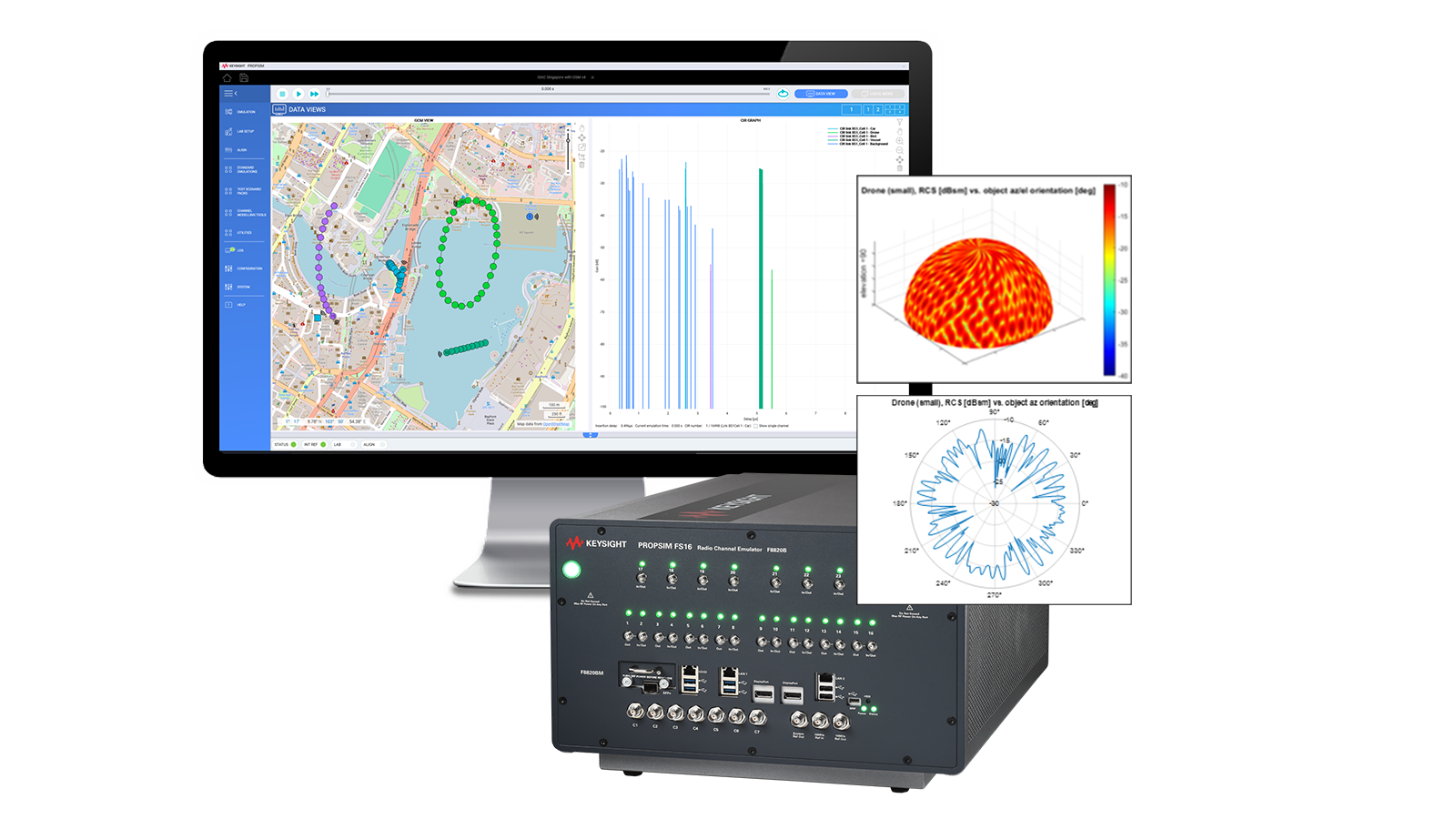
See how Keysight’s Channel Studio modeling software supports monostatic, bistatic, and multi-static sensing configurations. Engineers can define target trajectories with dynamic speed profiles and orientations, configure multiple targets, import radar cross-section (RCS) patterns, and design or import three-dimensional antenna patterns.
The modeled scenario can then run in real time on a Keysight PROPSIM channel emulator. An MXG signal generator and MTRX multichannel transceiver reproduce the transmit and receive functions of a base station in a monostatic sensing setup. The demonstration uses a 5G New Radio (NR) signal. Since PROPSIM is waveform-agnostic, the same testbed can also support alternatives such as orthogonal time frequency space (OTFS).
Coherent signal capture across eight receiver ports supplies in-phase and quadrature (I/Q) data for radar processing to produce range-Doppler heat maps and angle estimation, supporting target detection and tracking.
Watch the short video to learn how scenario modeling, real-time channel emulation, and signal analysis work together for end-to-end ISAC testing in a controlled lab environment.
您希望搜索哪方面的内容?