
10 Reasons AI-Scale Ethernet Validation Needs a New Class of Test Systems
Infographics
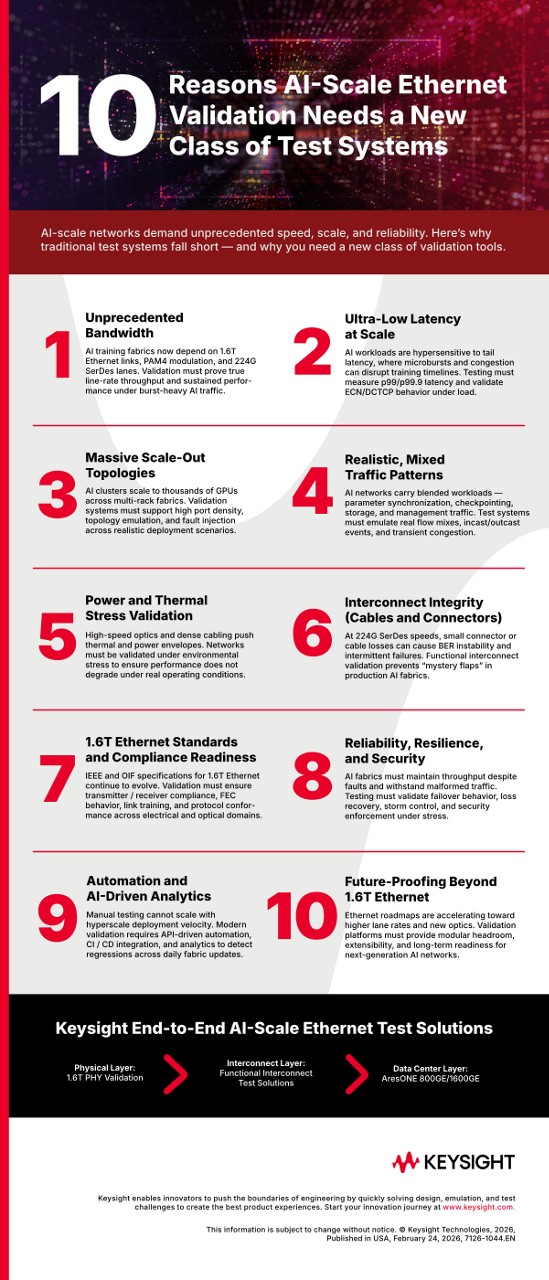
AI workloads are rapidly transforming data center and networking requirements, pushing Ethernet technology into an entirely new era. As AI training and inference clusters scale to thousands of interconnected endpoints, networks must deliver unprecedented bandwidth, ultra-low latency, and extreme reliability. Traditional Ethernet validation approaches, built for earlier generations of networking, can no longer keep pace with the demands of AI-scale infrastructure. This infographic highlights ten critical reasons why AI-scale Ethernet validation requires a new class of test solutions.
1. AI workloads are driving the need for unprecedented bandwidth, with next-generation Ethernet links reaching 1.6T speeds. Legacy test systems are often unable to validate performance at these data rates, creating a gap between evolving network technology and available validation tools.
2. AI systems require ultra-low latency, often at microsecond-level response times, to ensure efficient training cycles and real-time inference. Testing must therefore capture latency behavior with far greater precision than traditional methods.
3. AI networks are built for massive scale-out. Clusters may include thousands of endpoints, each requiring high-density interconnect validation. Ensuring consistent performance across such large deployments demands scalable, automated test architectures.
4. Compliance at 1.6T becomes increasingly important as standards evolve. Rigorous validation is required to confirm interoperability, signal integrity, and adherence to emerging Ethernet specifications.
5. Power and thermal constraints become major challenges at extreme speeds. High-speed links raise power draw and heat generation, meaning validation must include stress testing under real-world operating conditions.
6. As standards continue to evolve, compliance validation remains a recurring requirement, reinforcing the need for tools designed specifically for next-generation Ethernet rather than retrofitted legacy solutions.
7. Future-proofing is essential. AI-driven networks will rapidly increase in complexity, bandwidth demands, and architectural diversity. Validation tools must keep pace with these changes to remain effective across multiple technology generations.
8. Automation and AI-driven analytics are now critical components of modern testing. Integrated automation improves efficiency, while advanced analytics help identify performance bottlenecks and failure modes faster than manual workflows.
9. AI security and reliability are growing concerns. Testing must ensure network resilience against data loss, faults, and potential attacks, since AI workloads depend on continuous, high-integrity data movement.
10. Achieving high ROI and efficiency is a key driver. Advanced test solutions maximize throughput, reduce validation time, and help minimize overall infrastructure costs.
Keysight’s end-to-end AI-scale Ethernet test solutions address these challenges across the physical layer, interconnect layer, and data center layer. From 1.6T PHY validation to functional interconnect testing and high-speed Ethernet data center validation platforms such as AresONE, Keysight enables innovators to meet the demands of AI-scale networking with confidence.
This new era of Ethernet requires more than incremental improvements in testing — it demands a fundamentally new class of validation tools built for speed, scale, automation, and reliability in AI-driven networks.