
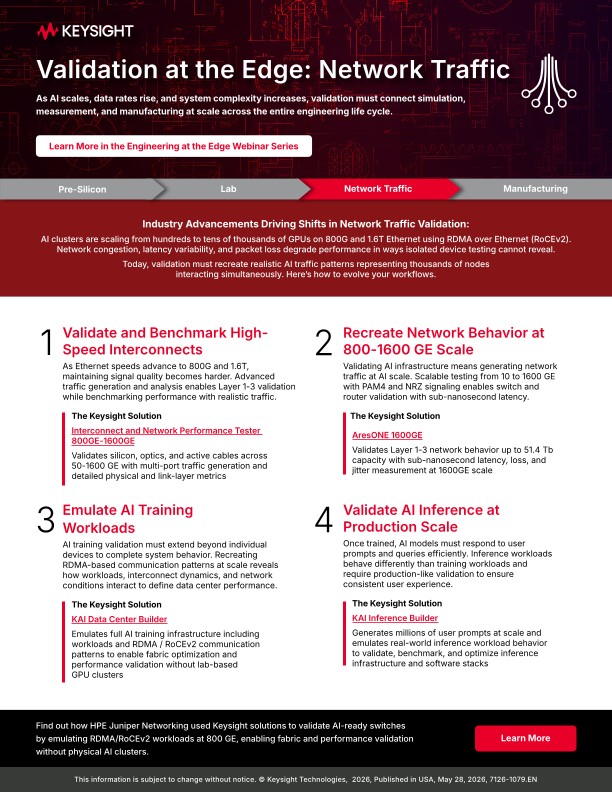
Validation at the Edge: Network Traffic
Infographics
This executive insights handout serves as a companion resource to Episode 3 of Keysight's "Engineering at the Edge" webinar series, a four-part virtual event exploring next-generation system validation in 2026.
AI infrastructure has entered a new phase of scale. Clusters have grown from hundreds of GPUs to tens of thousands, interconnected over 800G and 1.6T Ethernet using RDMA over Ethernet (RoCEv2). At this scale, network behavior is no longer predictable from isolated device testing. Congestion events, latency variability, and packet loss emerge from the interaction of thousands of simultaneous flows — and these failure modes cannot be anticipated without recreating realistic AI traffic patterns at production scale.
As data center fabrics grow more complex and interconnect speeds double, the challenge for network validation teams is not just keeping up with higher line rates. It is recreating the full dynamic of an AI training or inference workload — including bursty RDMA traffic, all-reduce communication patterns, and congestion control behavior — in a controlled lab environment before deployment. Traditional traffic generators built for enterprise networking were not designed for this workload profile, and the gap between lab validation and production performance has become a critical risk.
The handout addresses four challenges network and infrastructure teams face today. Validating and benchmarking high-speed interconnects at 800G–1600GE requires traffic generation and analysis spanning Layer 1 through Layer 3. Recreating network behavior at AI scale means generating traffic patterns that reflect how thousands of GPUs actually communicate, including PAM4 and NRZ signaling, sub-nanosecond latency measurement, and switch and router validation at 51.4 Tb capacity. Emulating AI training workloads requires full infrastructure emulation including RDMA/RoCEv2 communication patterns and workload-driven congestion — revealing how fabric performance responds under real AI training conditions without requiring a physical GPU cluster. Validating AI inference at production scale addresses a distinct challenge: inference workloads are latency-sensitive and user-driven, requiring generation of millions of prompts at scale to benchmark and optimize inference infrastructure and software stacks.
Keysight solutions featured include the Interconnect and Network Performance Tester (800GE–1600GE), which validates silicon, optics, and active cables across 50–1600 GE with multi-port traffic generation and detailed physical and link-layer metrics; AresONE 1600GE, which validates Layer 1–3 network behavior up to 51.4 Tb capacity with sub-nanosecond latency, loss, and jitter measurement; KAI Data Center Builder, which emulates full AI training infrastructure including RDMA/RoCEv2 communication patterns to enable fabric optimization and performance validation without lab-based GPU clusters; and KAI Inference Builder, which generates millions of user prompts at scale to validate, benchmark, and optimize inference infrastructure and software stacks.
The handout features a real-world success story: Juniper Networks used Keysight to validate AI-ready switches by emulating RDMA/RoCEv2 workloads at 800 GE, enabling fabric and performance validation without physical AI clusters.
This resource is designed for network engineers, data center architects, AI infrastructure engineers, and technical decision-makers responsible for validating high-speed Ethernet networks, AI training fabrics, and inference deployments at scale.
As part of the Engineering at the Edge series, this handout connects to the other three episodes covering Pre-Silicon Validation, Lab Validation, and Manufacturing Validation across the entire engineering lifecycle.