


Why Use Eggplant Monitoring
Synthetic monitoring that tests what customers do.
Application performance monitoring tells you whether systems and services respond — not whether checkout is broken in a specific browser; login is timing out from a specific region, or a key journey is slowing down. As teams ship AI-powered features, these blind spots grow.
Eggplant Monitoring simulates real user journeys across websites, web apps, and APIs around the clock; no agents, no code changes, no infrastructure access required. Monitor SaaS applications, third-party portals, cloud environments, and AI connected services from an end-user perspective.
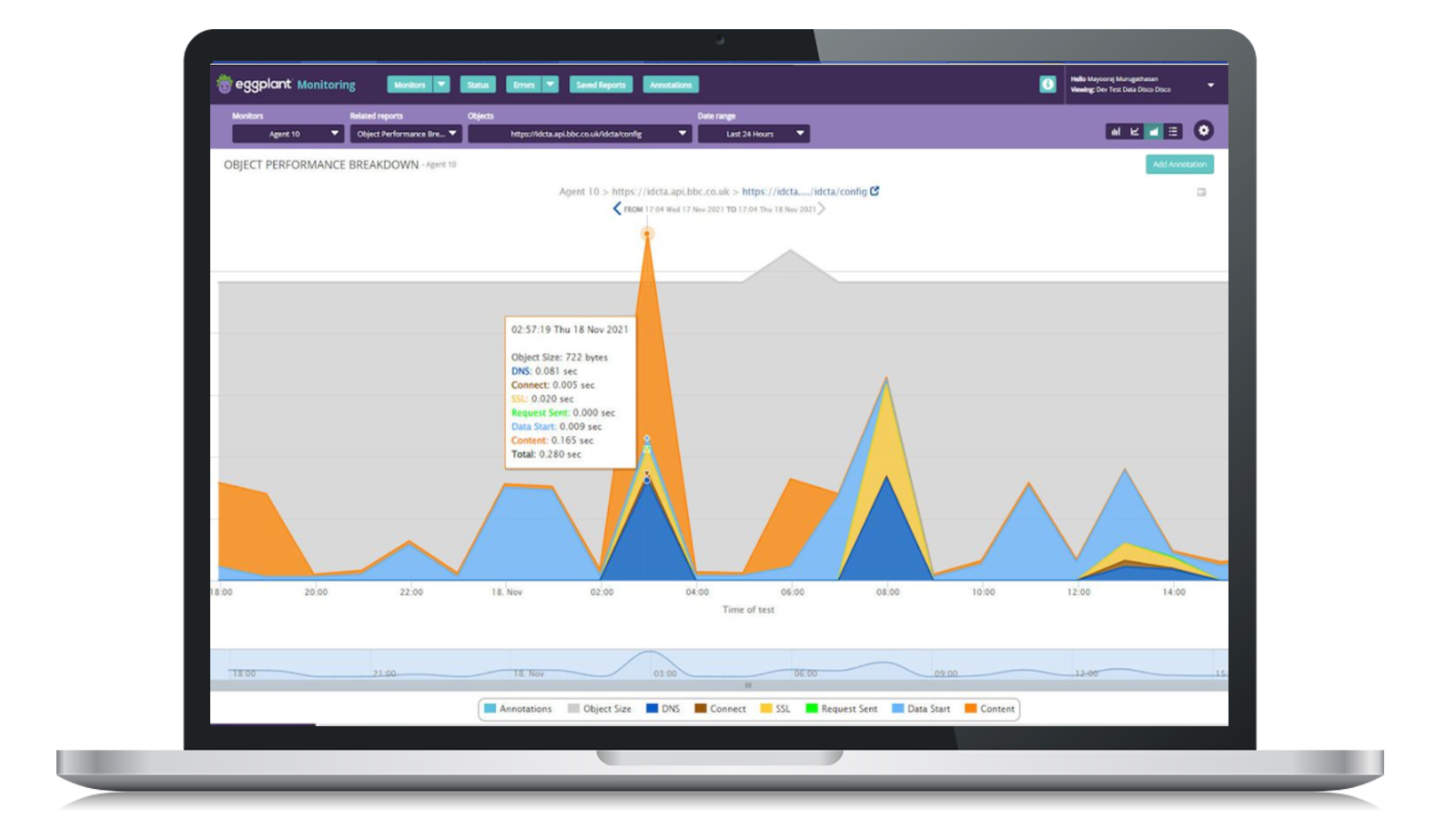
When something slows or breaks, you find out first. Alerts, dashboards, and reports show which step in which journey is hurting. As a managed service, monitoring coverage stays current as your application evolves, reducing maintenance overhead.
 See What Customers SeeSimulate the actual journeys your customers complete (login, search, add-to-cart, checkout), so you spot friction before it costs you conversions.
 Monitoring That Works for YouCustomizable dashboards, management reports, and API access. Track what matters to your business, not what the tool decides.
 Instant Alerts, Fast FixesAlerts and webhook-based integrations help your team act when a journey slows or breaks. Mean-time-to-detect measured in minutes, not hours.
 Manage AI-Powered WorkflowsAs AI agents and MCP server integrations become part of your application stack, keep them in scope. Eggplant Monitoring detects when AI-connected services slow, fail, or return unexpected results before your users notice.
Key Outcomes

Pages that load fast keep visitors engaged. A 1-second delay cuts conversion by 7%. Eggplant Monitoring catches the slowdowns before they cost you.

Friction costs money. Eggplant Monitoring flags borken steps, regional timeouts, and slow journeys the moment they emerge, so your team fixes issues before revenue is lost.

AI features and MCP server integrations are becoming business-critical. Eggplant Monitoring extends synthetic coverage to these new features, so you know when an AI workflow breaks before anyone else does.

Synthetic journey data turned into clear performance reports. Know which journey, step, account, or location needs attention next.
Resources to Get You Started
Empower your business with real-time insights into site speed and availability, backed by fully tailored alerts that keep you ahead of issues before they impact your customers.


Blogs
eBooks
Eggplant Monitoring

Case Studies
User-Centric Performance and Load Testing Saves Digital Campaign
eBooks
Traffic, Trade, and Timing
Have Questions? We've Got Answers
Eggplant Monitoring is a synthetic monitoring and digital experience monitoring solution from Keysight. It simulates real user journeys such as login flows, search, checkout, and other critical workflows using scheduled synthetic monitors. When a step slows down or fails, the platform surfaces status, alerts, reports, and monitoring data through dashboards and APIs. Unlike application performance monitoring (APM), which measures server-side health, Eggplant Monitoring measures what customers experience. It is available as a managed monitoring service.
By detecting problems before customers report them. Eggplant Monitoring runs scheduled synthetic journeys, so degraded performance, broken steps, and regional issues can surface quickly. Teams use the data to fix issues proactively, prioritize engineering work based on customer impact, and support performance SLA reporting with evidence.
Yes. As AI agents and Model Context Protocol (MCP) server integrations become part of production applications, Eggplant Monitoring can extend synthetic coverage to those workflows. If an AI-connected service slows or fails, whether it's retrieval step, an agent action, or an API dependency, Eggplant Monitoring surfaces the issue at the journey level the same way it wojld for any other critical user flow.
Yes. Eggplant Monitoring can share monitoring data through query APIs and can support alerting workflows through webhook profiles and other integrations. It is designed to complement APM rather than replace it. APM tells you what your servers are doing; Eggplant Monitoring tells you what your customers are experiencing.
Three differences. First, it monitors the user-journey level, not just the endpoint level, so it catches issues that simple availability checks miss. Second, it is offered as a managed monitoring service, so you get enterprise synthetic monitoring without staffing a dedicated team. Third, it provides reporting and API access so teams can analyze live and historic monitoring data in their own dashboards and workflows.
Yes. Eggplant Monitoring is designed for enterprise environments, with account-based access, Keysight Passport login, API authentication, personal access tokens, and controls for monitoring data extraction. It supports scalable synthetic monitoring across multiple accounts, monitors, and business-critical journeys.