


Why Use Optical Network Design
Design, provision, and optimize optical links with automated analysis and intuitive workflows.
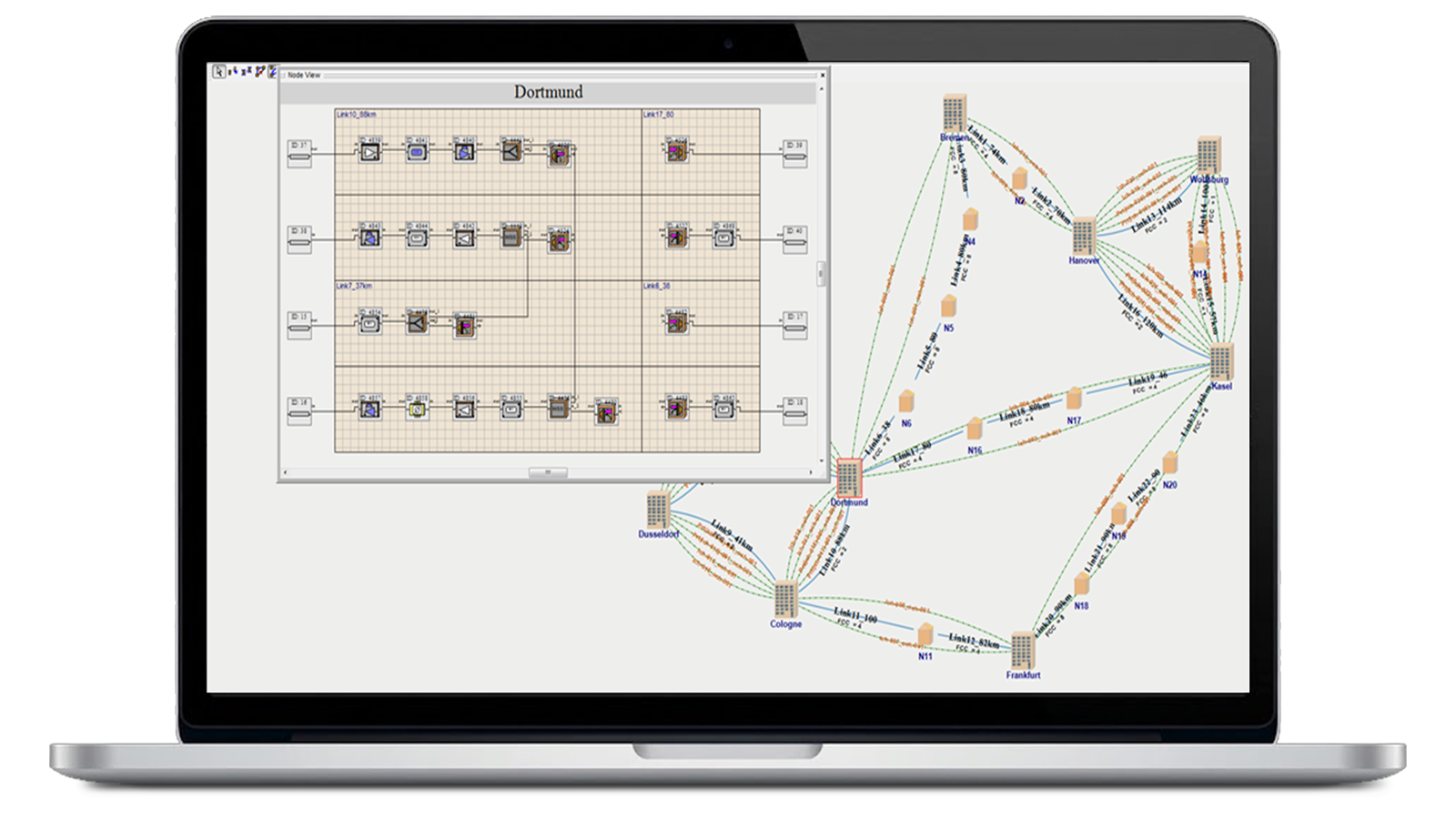
Modern optical networks demand accurate performance prediction, efficient provisioning, and rapid design validation. This solution simplifies optical link engineering through an intuitive graphical environment that combines network design, equipment placement, and real-time performance analysis. Engineers can instantly evaluate critical metrics such as power, dispersion, OSNR, and nonlinear effects while building their networks, eliminating the limitations and manual effort associated with spreadsheet-based workflows. Support for point-to-point, ring, branched, mesh, and DWDM network architectures enables rapid deployment across a wide range of applications. Built-in automation tools help optimize amplifier settings, network equalization, regeneration planning, and equipment selection, while customizable reporting and bill-of-material generation streamline project delivery. The result is faster design cycles, improved network performance, greater engineering consistency, and reduced deployment risk.
Key Capabilities

Instantly evaluate performance during network design.

Build networks using intuitive visual workflows.

Analyze OSNR, dispersion, and nonlinear effects.

Support linear, ring, mesh, and branched networks.

Optimize amplifiers, equalization, and regeneration planning.

Create performance reports and material lists.
Resources to Get You Started
This brochure introduces VPIlinkDesigner, a graphical tool for designing and provisioning optical networks across linear, branched, hub, ring, and mesh topologies. It supports equipment placement, automated wavelength allocation, and systemwide analysis of fiber impairments and equipment limitations. Performance displays update as designs change, helping engineers assess channel power, dispersion, noise, and nonlinear effects. Equipment libraries and built-in reporting enable consistent designs, cost comparisons, and generation of bills of materials for carriers, private network operators, and system integrators.


blogs
Completing Keysight's End-to-End Photonic Design Workflow
Brochures
Photonic Design Automation for Components, Systems & Networks

Have Questions? We've Got Answers
Optical Network Design is used to design, provision, and analyze optical transmission networks while providing real-time performance feedback throughout the engineering process.
The software supports point-to-point, linear, branched, ring, mesh, and complex DWDM network architectures with multiple nodes and repeater locations.
Engineers can analyze power, dispersion, OSNR, and nonlinear impairments including SPM, XPM, FWM, and SBS for each channel.
Yes. Built-in automation tools assist with amplifier gain settings, equalization, padding, transceiver placement, OADM/ROADM configuration, and regeneration planning.
By replacing manual spreadsheet workflows with automated modeling, real-time calculations, reporting tools, and reusable component libraries, engineers can design networks significantly faster and with greater accuracy.