


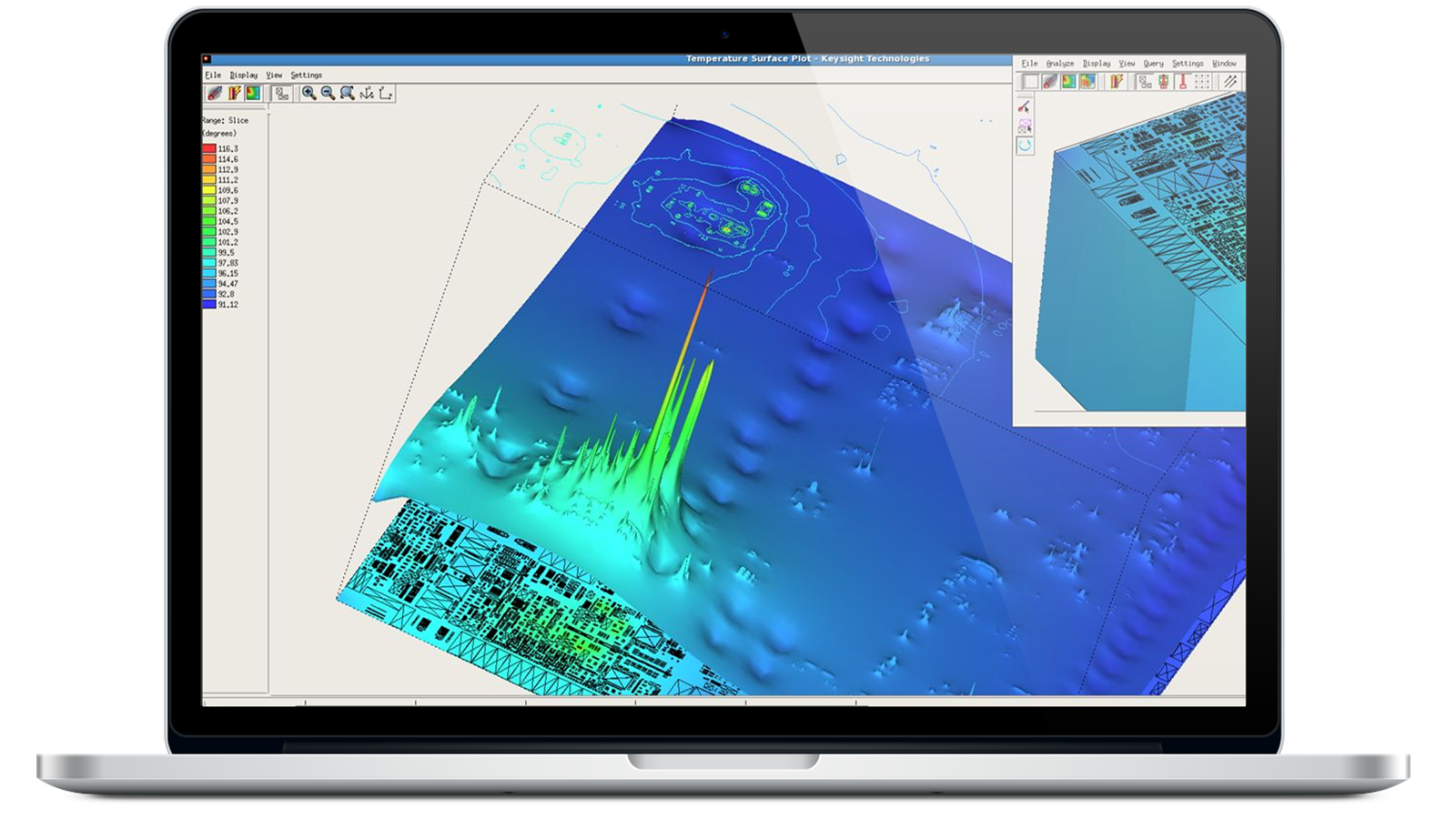
Why Use Keysight Thermal Design (Heatwave)
Accurate full-chip 3D electrothermal simulation for chips and stacked-die System-in-Package (SiP).
Chips and SiP designed for high-speed, mixed-signal and RF applications have localized high power density during transient and steady-state operation, causing adverse temperature effects on performance and reliability.
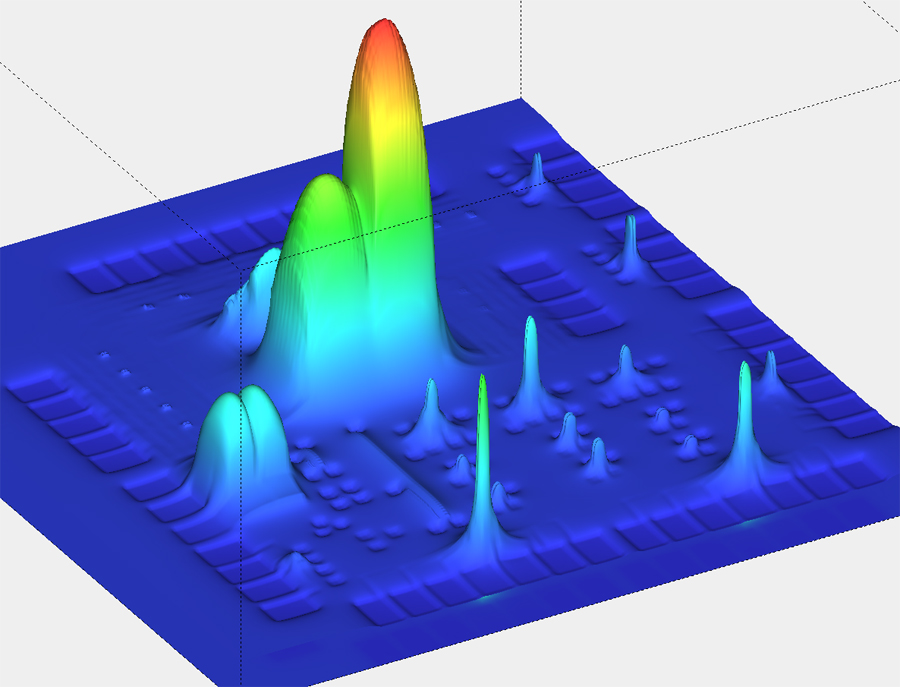
Keysight Thermal Design (Heatwave) accurately detects nanoscale dynamic temperature variation and hazardous hotspots at the device geometry level during active operation. The electrothermal analysis results show time-varying 3D temperature profiles with nanoscale resolution, which enables you to precisely locate and fix hazardous hot spots in your chip or SiP design to avoid costly failures after deployment.
Keysight Thermal Design works within your IC design flow, including Cadence Virtuoso, Keysight ADS, and interfaces with Synopsys HSpice and Siemens Eldo to determine dynamic device temperatures for circuit simulators to accurately simulate temperature-dependent electrical performance, such as amplifier gain and transceiver Error Vector Magnitude (EVM) during operation. It eliminates erroneous and costly assumption of nominal temperature in your chip simulation that can lead to hardware failure after tapeout.
Key Capabilities

Compute the full temperature profile of your device.

Uncover temperature variations in mixed-signal designs.

Simulate temperature without laborious data preparation.

Input thermal analysis data in your circuit simulator.

Analyze geometric features at the submicron scale.

Detect reliability issues with realistic temperature data.
Resources to Get You Started
Reveal Thermally-Induced Circuit Failures Before Tape-Out
Temperature variations cause measurement and simulation uncertainty. Taking the average temperature of a chip to run a circuit simulation does not provide enough accuracy for your device. Learn how Keysight Thermal Design eliminates the need to estimate device temperature by revealing thermally-induced circuit failures with resolution and accuracy.
Webinars
Using Electro-Thermal Simulation in Your Next IC Design

技术资料
Thermal Design Temperature-Enabling Your Simulations
参考指南
Who uses Thermal Design (HeatWave)?
Article Reprints
HeatWave Technical Papers
Case Studies
HeatWave Case Studies
Explore Heatwave Bundles
EDA software bundles provide designers with pre-configured combinations targeted to a specific design workflow.


Thermal Design Core
Electrothermal simulator for System-on-Chip (SoC) design flows.
Electrothermal simulator for System-on-Chip (SoC) design flows.
Thermal Design Steady-State Analog
Electrothermal simulator for Analog/Mixed-Signal design flows that interfaces with Cadence Virtuoso, reading power from, and annotating temperature to your circuit-simulation.
Electrothermal simulator for Analog/Mixed-Signal design flows that interfaces with Cadence Virtuoso, reading power from, and annotating temperature to your circuit-simulation.
Have Questions? We've Got Answers
Keysight Thermal Design is a device-level electrothermal simulation solution for integrated circuits and stacked-die SiP designs. It computes a detailed 3D temperature profile across an entire chip and feeds instance-specific temperature data directly into circuit simulation tools. This enables engineers to understand how thermal effects influence circuit performance before tape-out, helping improve design accuracy, reliability, and product quality.
As semiconductor devices become more compact and power-dense, temperature variations can significantly impact circuit behavior. Hotspots, uneven heat distribution, and localized thermal effects can degrade performance and reliability. Keysight Thermal Design helps engineers identify thermal issues early by providing accurate operational temperature data, allowing corrective action before fabrication and reducing costly redesigns or field failures.
Traditional simulations often assume uniform or average chip temperatures, which can overlook localized heating effects. Keysight Thermal Design calculates the actual temperature of individual devices using layout geometry, material properties, power dissipation, and package characteristics. The resulting temperature data is automatically incorporated into circuit simulations, producing more realistic predictions of performance under real operating conditions.
Yes. Temperature is a major contributor to failure mechanisms such as electromigration, NBTI/PBTI, and time-dependent dielectric breakdown (TDDB). Keysight Thermal Design computes accurate temperatures for devices and interconnects, enabling engineers to perform more realistic reliability assessments. This helps identify wear-out risks, estimate product lifetime, and improve long-term device robustness before manufacturing.
Yes. Keysight Thermal Design supports thermal simulation with incomplete layouts, making it useful for thermal floor-planning during the early stages of development. Engineers can simulate selected chip regions while using abstractions for unfinished areas, helping identify potential thermal hazards sooner and guiding design decisions that improve thermal performance throughout the development cycle.