
Resolving PSD Measurement Differences
散页
PSD Measurement Differences
Automotive Ethernet provides vehicles with faster data communications which is vital for today’s cars and the connected vehicles of the future. An important component of validating an automotive Ethernet transmitter is the power spectral density (PSD) test, which measures a signal's power content versus frequency. It shows how the energy of a signal is distributed. The IEEE’s 100BASE-T1 standard for Automotive Ethernet provides the specification for testing PSD under test mode #5.
Test mode #5 can be performed using a signal analyzer or an oscilloscope with spectral-analysis capabilities. Although either a signal analyzer or oscilloscope can be used to measure the PSD of an Ethernet device, the measurement results can differ by 3 to 4 dB.
Signal Analyzer
When performing a PSD test with a signal analyzer, a balun converts the DUT’s differential transmission to a single-ended input with a 50 Ω input impedance.
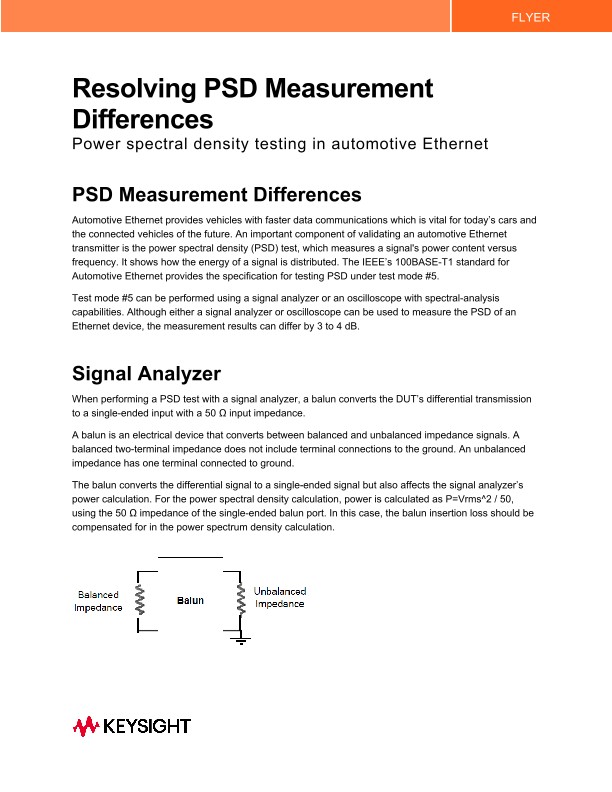
A balun is an electrical device that converts between balanced and unbalanced impedance signals. A balanced two-terminal impedance does not include terminal connections to the ground. An unbalanced impedance has one terminal connected to ground.
The balun converts the differential signal to a single-ended signal but also affects the signal analyzer’s power calculation. For the power spectral density calculation, power is calculated as P=Vrms^2 / 50, using the 50 Ω impedance of the single-ended balun port. In this case, the balun insertion loss should be compensated for in the power spectrum density calculation.
Oscilloscope
Given that Keysight Infinium oscilloscopes with FFT function allow spectrum measurements to be configured similarly on spectrum analyzers (i.e., setting start, stop, and center frequency and RBW), the PSD measurement results match very well on both automotive ethernet test mode five signals.
Summary
Two PSD measurement graphs are measured on the APM1000E 1000base-T1 PHY in test mode 5 (PSD), each with a spectrum analyzer (left) and an Infiniium oscilloscope (right) with the same start/stop/center frequency and RBW (100 kHz) conditions. They are nearly identical in test results. PSD mask specified by IEEE 802.3bp (for 1000base-T1), including power levels, is required for the 1000BASE-T1 PHY being tested.