
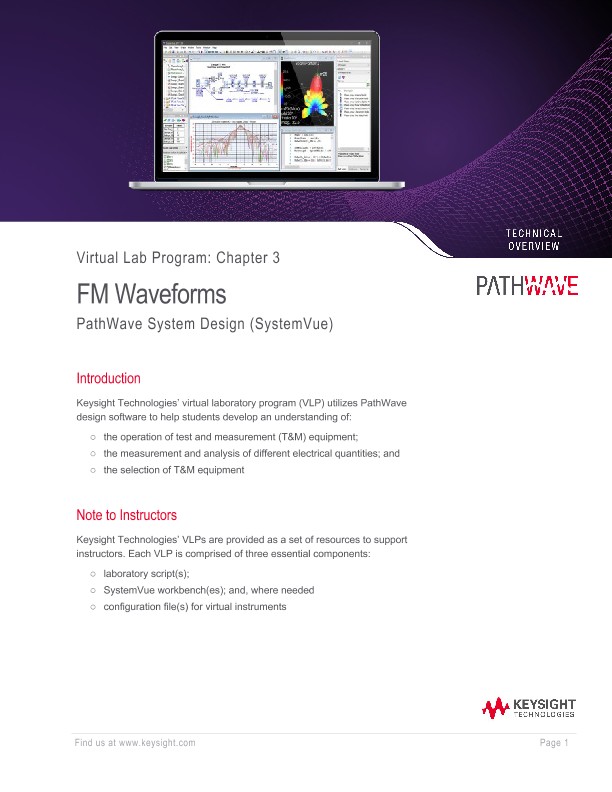
Virtual Lab Program: Chapter 3 FM Waveforms
技术概述
PathWave System Design (SystemVue)
Introduction
Keysight Technologies’ virtual laboratory program (VLP) utilizes PathWave design software to help students develop an understanding of:
o the operation of test and measurement (T&M) equipment;
o the measurement and analysis of different electrical quantities; and
o the selection of T&M equipment
Note to Instructors
Keysight Technologies’ VLPs are provided as a set of resources to support instructors. Each VLP is comprised of three essential components:
o laboratory script(s);
o SystemVue workbench(es); and, where needed
o configuration file(s) for virtual instruments
The first component of the VLP, the script (such as this), is self-contained, thus allowing instructors to use it fully (as it stands) or partially (together with other material). Each script is tagged with a set of identifiers that include references to the: level of difficulty; experiment number; stimulus number; objective; and virtual instrument to be used. A summary of these identifiers with cross-references to the scripts and workbenches is given in the instructors’ overview at the end of this section.
The second component of the VLP is a SystemVue workbench. This can be thought of as a signal generator and is arranged in such a way that the student can select predefined signal characteristics using a simple top-level interface. Beneath this, SystemVue code blocks interpret the students’ input selection and correspondingly configure the parameters of schematic components. Upon execution of the simulation, SystemVue generates the required signal which can then analyzed and visualized in the third component of the VLP, the virtual instrument, and/or in SystemVue. In addition to the preconfigured settings, the instructor may adapt the parameter settings in order to provide alternative configurations. The instructor may also choose to adapt the supplied SystemVue workbenches according to their specific requirements and teaching objectives.
Software Versions
The workspaces included in this VLP were developed in Keysight PathWave System Design (SystemVue) 2021 and were tested using Keysight PathWave Vector Signal Analysis (89600 VSA) Version 2020. These software packages are recommended as the basis for the VLP.
Instructors’ Overview
The SystemVue workspace “FM waveforms.wsv”—summarized in the table below—has been designed to provide the instructor with a total of 4 x 2 x 8 x 4 x 4 = 1024 experiments.
Downloading VLP Packages
There are several different VLP packages available for download. To download the various packages, go to www.Keysight.com/find/PathWave-System-Design-Virtual-Labs. This landing page contains links to the PDF lab scripts, workspaces, and configuration files.
Background for Students
In this set of exercises, you will create a variety of signals and visualize them in both the time and frequency domain using Keysight PathWave System Design (SystemVue). A common SystemVue workspace is used for all of the exercises. This is conceptually similar to a laboratory workbench comprised of a signal generator (the source) and signal analyzers (the sinks). The latter includes a time domain data sink which can be thought of as an oscilloscope and a frequency domain sink which is similar to a spectrum analyzer.
To begin with the exercises, it is assumed that you have a PC or laptop on which the suitable software has been installed and that you have access to the relevant workspace which forms part of the VLP.
Prerequisites
In order to work through Keysight Technologies’ VLP (either fully or partly), a basic level of competence with SystemVue is required. This should include the ability to:
o open a workspace;
o navigate through the workspace tree and view its components;
o execute simulations;
o adjust workspace parameter settings (mainly by using pre-configured sliders); and visualize simulation results.
Students who are unfamiliar with any of the above aspects of SystemVue should take advantage of the on-line resources provided in Table 1—a Keysight account might be required.