
D9120FECP FEC (KP4) 400GE (100G Optical Lane) Decode/Trigger
技术资料
Introduction
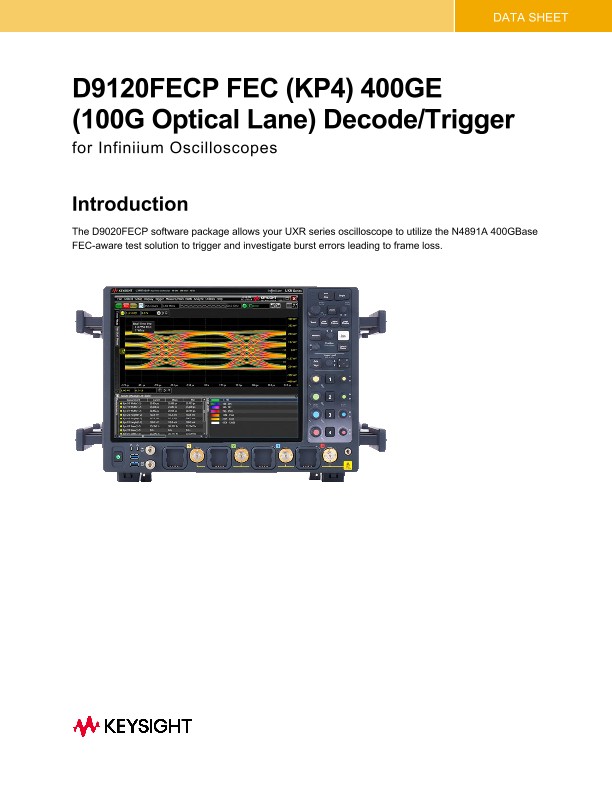
The D9020FECP software package allows your UXR series oscilloscope to utilize the N4891A 400GBase FEC-aware test solution to trigger and investigate burst errors leading to frame loss.
400GbE KP4 FEC Overview
The steadily increasing demand for more computing power and bandwidth fueled by cloud applications has accelerated the deployment of higher speed interfaces in datacenters. The move from NRZ-based 100G interfaces to PAM4-based 400G interfaces exponentially increased the level of complexity for the development of stable port electronics in all networking devices. 400G links typically operate at rather high intrinsic bit error rates (BER) and forward error correction (FEC) is therefore required. The combination of adaptive equalization and FEC has drastically increased the level of complexity in the characterization and validation of silicon devices, application specific integrated circuits (ASICs), fiber and copper interconnects, optical transceivers, and the port electronics of switches and routers. Identifying potential performance and interoperability issues at an early stage is critical as answers are complex and time-consuming to solve.
Testing FEC-enable links
The IEEE 400GBASE standard clauses require the use of the Reed-Solomon code RS (544,514), also known as KP4, to ensure error-free operation. When bit errors are randomly distributed, the system margin and resulting Frame Loss Ratio (FLR) can be easily derived from the pre-FEC BER. However, besides jitter mechanisms and pattern-dependent effects (like inter-symbol interference, ISI), adaptive Decision Feedback Equalizer (DFE) which are necessary to cancel impact of reflection in the links are a major source of error bursts, which can exceed the error correction capability of the FEC, resulting in loss of the entire FEC code word – several thousands of bits of lost data. As such effects have a direct impact on interoperability, 400G Ethernet standards compliance tests for electrical and optical interface require meeting both a conventional BER limit, as well as a Frame Loss Ratio (FLR) measurement.
The Need for A New Tool (Finding & Analyzing)
The new D9120FECP software package allows your UXR series oscilloscope to utilize the N4891A 400GBase FEC-aware test solution to trigger on and investigate burst errors leading to frame loss.
Have you got an unacceptable Frame Loss Ratio (FLR) even with the following results from your real-time scope or BERT?
• Passing electrical and optical transmitter and receiver compliance test.
• With transmitter TDECQ and receiver BER/SER in spec.
• No burst errors is found in real-time scope and stressed receiver test.
The Infiniium UXR with the new D9120FECP can locate and investigate these bursts of errors with help from the N4891A. The UXR gets a trigger from the N4891A to isolate a burst of errors and also the correct values of the symbols near that trigger (and optionally, the symbols the N4891A received that caused the trigger.) With the trigger and information from N4891A, the correct symbols can be used to highlight errors in the UXR received symbols. Thus, the cause of the burst errors (hence the possible frame loss) can be investigated.
D9120FECP Overview
The D9120FECP FEC (KP4) 400GE Decode/Trigger software package with Infiniium UXR Series oscilloscope makes it easy to debug and test designs:
• Identifies FEC errors in 400G optical waveforms on UXR oscilloscopes.
• Works with N7004/5A O/Es to capture 50/100G (26/53GBd PAM4) optical lanes on 1 to 4 channels.
• Takes triggers from N4891A/A400GE to capture infrequent bursts of errors.
• Imports 50G PAM4 symbols near the trigger from N4891A/A400GE over LAN.
• Aligns both FEC-expected and Trigger electrical PAM4 symbols from N4891A/A400GE with 50G or 100G optical PAM4 symbols recovered from acquired optical waveform.
• Color codes and searches for errors, either transmitter errors (where waveform symbols do not match FEC-expected symbols) or receive errors (where trigger symbols from the N4891A/A400GE do not match the FEC-expected signals).
• Allows user to modify PAM4 optical clock recovery, equalization, and thresholds to see if errors can be eliminated on the captured symbols.
• Allows user to quickly identify if errors are at the electrical or optical level.