
N6820MR1E Modulation Recognition (MR1) Feature
技术概述
Introduction
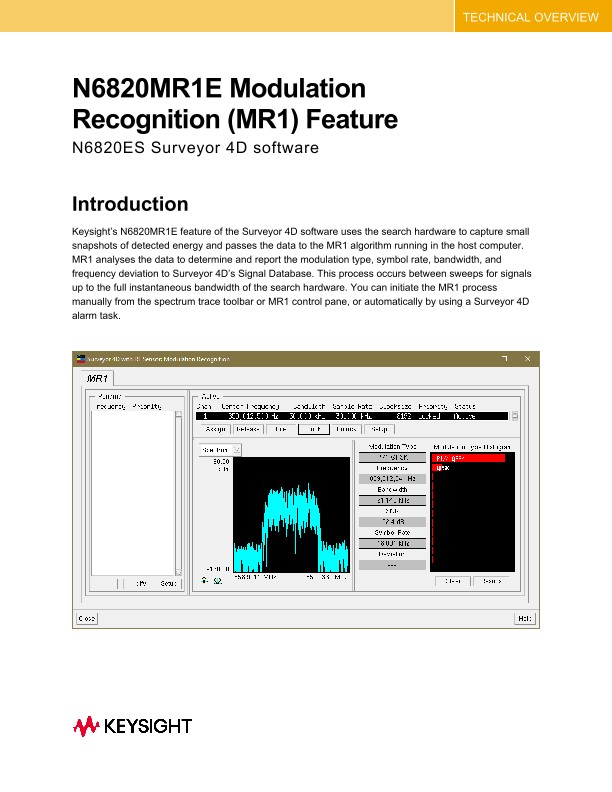
Keysight’s N6820MR1E feature of the Surveyor 4D software uses the search hardware to capture small snapshots of detected energy and passes the data to the MR1 algorithm running in the host computer. MR1 analyses the data to determine and report the modulation type, symbol rate, bandwidth, and frequency deviation to Surveyor 4D’s Signal Database. This process occurs between sweeps for signals up to the full instantaneous bandwidth of the search hardware. You can initiate the MR1 process manually from the spectrum trace toolbar or MR1 control pane, or automatically by using a Surveyor 4D alarm task.
MR1 wideband modulation recognition feature
The MR1 feature operates on I/Q time-series data to make a blind estimation of a signal’s internal parameters. When directed by either an alarm or a manual request, MR1 collects a small “snapshot” of the signal and sends that to a modulation recognition process. This arrangement allows Surveyor 4D to continuously sweep through the spectrum, detecting and logging signal external parameters while processing time domain data on selected signals to identify their internal parameters such as modulation format and symbol rate. MR1 can recognize the modulation types listed below:
• FSK
• 3-level FSK
• 4-level FSK
• 8-level FSK
• Analog FM (incl. multi-level FSK not shown above)
• MSK (incl. GMSK, offset (a.k.a. staggered) QPSK)
• BPSK
• QPSK (incl. DQPSK)
• Pi/4 QPSK (incl. Pi/4 DQPSK)
• 8 PSK
• 16 PSK
• V.29 modem
• 16 QAM
• 32 QAM
• 64 QAM
• 128 QAM
• 256 QAM
• AM
• AM DSBSC
• LSB
• USB
• OOK (a.k.a. ASK)
• 4PAM (a.k.a. 4-level ASK)
• Manual morse
• Machine morse
• Pure carrier
• Noise
• Unknown Digital (reports symbol rate of other digital modulation formats
MR1 operates on blocks of data and makes an estimate of the modulation type for each data block in the overall recording. As the MR1 algorithm proceeds through the recording, it scores the results and displays the scoring in a histogram format. A report of the resulting summary of the scoring is sent to the Signal Database. The MR1 algorithm block size is user-defined and adjustable by powers of two (i.e., 1024, 2048, 4096, etc.).
The signal internal parameters extracted during the MR1 process are saved into Surveyor 4D’s Signal database and, if enabled, to the PostgreSQL database for more permanent storage. The measured parameters include:
• Center frequency
• Bandwidth
• Signal-to-noise ratio
• Modulation type
• Symbol rate
• Frequency deviation
The MR1 control pane enables manual assignment and feature control. For example, MR1 can be assigned to process either live data from the search receiver at a specific frequency and bandwidth, or time-series data from a file as a post-process. Other controls include over-sampling rate, block size, and duration of the analysis.
Working with file data provides a degree of analysis not available when working with live data from the search receiver. You can adjust some of the algorithm parameters to accommodate the specific type of signal. If the signal is bursted, a user can work carefully through the entire file, front to back, to isolate and identify the burst modulation. Controls are available to facilitate the signal analysis as shown.