
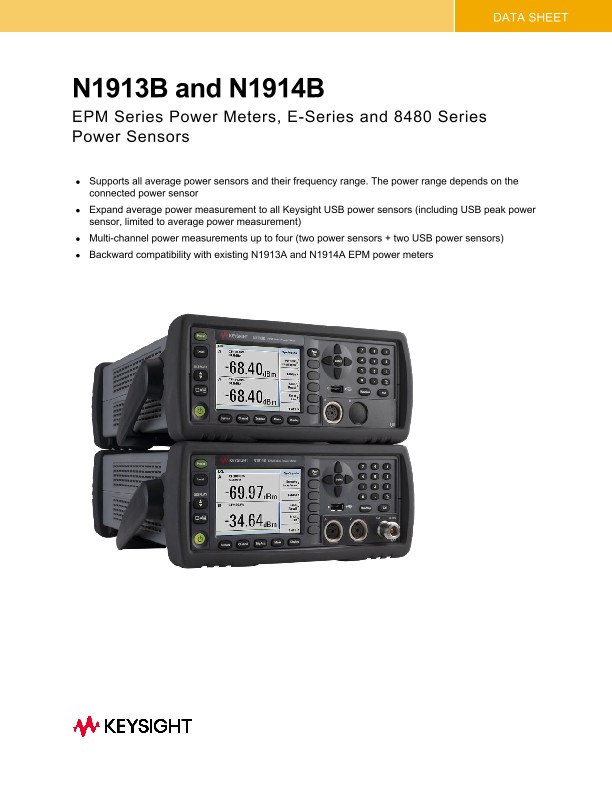
N1913B and N1914B EPM Series Power Meters, E-Series and 8480 Series Power Sensors
技术资料
• Supports all average power sensors and their frequency range. The power range depends on the connected power sensor
• Expand average power measurement to Keysight USB power sensors (including USB peak power sensor, limited to average power measurement)
• Multi-channel power measurements up to four (two power sensors + two USB power sensors)
• Backward compatibility with existing N1913A and N1914A EPM power meters
Do More with N1913/14B New EPM Series Power Meters
• Get up to four channels1 to speed and simplify RF average power measurements
• View test results more easily with the color LCD readout in an average power meter
• Go beyond GPIB with USB and LAN/LXI-C interfaces
• Automate frequency/power sweep measurements with the optional external trigger in/out feature
• Backward compatibility with existing N1913A and N1914A EPM power meters
• Enhance manufacturing test by connecting a large external monitor with the unique VGA output
As signals become more complex, it becomes more difficult to make fast, accurate power measurements. For years, you’ve depended on Keysight’s EPM Series power meters. Today, the Keysight N1913B and N1914B new EPM Series power meters are versatile, user-friendly replacements for the discontinued N1913A and N1914A. Get consistent results and greater capability - with the new EPM Series power meters.
Using New EPM Series Power Meters with BenchVue Software
The new EPM power meters are supported by the Keysight BenchVue software’s BV0007B Power Meter/ Sensor Control and Analysis app. Keysight BenchVue software for the PC accelerates testing by providing intuitive, multiple instrument measurement visibility and data capture with no programming necessary. You can derive answers faster than ever by easily viewing, capturing, and exporting measurement data and screen shots. BenchVue software license (BV0007B) is now included with your instrument.
For more information, www.keysight.com/find/BenchVue
New N1913/14B EPM Series Power Meter:
Applications and compatible sensors for average power measurements
Signal characteristics > |
CW |
Modulated |
Modulated |
||||
|
CW |
Pulse/average |
AM/FM profiled |
Mobile phone |
WLAN |
WPAN |
WMAN |
Typical application examples > |
Metrology lab |
Radar/ Navigation |
Mobile radio |
GSM, EDGE, GPRS Cdma®2000, cdmaONE IDEN, 3G, HSPA, LTE |
802.11a 802.11b 802.11g 802.11n |
Bluetooth® RFID ZigBee |
WiMaxTM Wibro |
Thermocouple sensors: 8480A/B/H, N8480A/B/H, R/Q8486A, N8486AR/AQ 1 |
• |
• |
• |
• Average only |
• Average only |
• Average only |
• Average only |
Diode sensors: 8480D, V8486A, W8486A 1, E8486A |
• |
• |
• |
• Average only |
• Average only |
• Average only |
• Average only |
Diode sensors compensated for extended range: E4412A/3A |
• |
FM only |
|||||
Two-path diode-stack sensors: E9300 Series |
• |
• |
• |
• Average only |
• Average only |
• Average only |
• Average only |
USB sensors: U2000A, U8480A, U2040/50/60 X-Series (except U2049XA & U2042/44/60 X-Series in Average mode only) |
• |
• |
• |
• Average only |
• Average only |
• Average only |
• Average only |
Performance characteristics
Specifications describe the instrument’s warranted performance and apply after a 30-minute warm-up. These specifications are valid over its operating/environmental range unless otherwise stated and after performing a zero and calibration procedure.
Supplemental characteristics (shown in italics) are intended to provide additional information, useful in applying the instrument by giving typical (expected), but not warranted performance parameters. These characteristics are shown in italics or labeled as “typical,” “nominal” or “approximate.”