
Integrated Digital Twins
散页
EXata Interface to PROPSIM
The EXata Interface to PROPSIM enables importing of RF propagation channel data generated by Keysight’s PROPSIM Geometric Channel Modeling (GCM) software into EXata scenarios. This integration of EXata and PROPSIM GCM leverages the strengths of both applications and provides a high-fidelity simulation/emulation platform for telecommunication systems.
For evaluating network (and application) performance, EXata uses emulation-quality protocol models though all layers of the communication protocol stack while relying on a simulated channel model for the radio frequency (RF) environment. Complimentary to EXata, PROPSIM emulates the impairments of complex 3D real-world radio channel conditions including dynamic multipath propagation, pathloss, blocking effects, doppler from mobility, noise, and synchronous programmable interference for testing a vast range of wireless devices, RF and radio systems. Channel data from PROPSIM GCM can now be imported into EXata, resulting in highly accurate simulations of RF and wireless communication networks.
The combination of EXata and PROPSIM GCM enables testing of large-scale communications networks in a low-cost, lab-based setting. Of note, PROPSIM GCM integration with EXata allows time-varying propagation channel models related to both space and air-borne platforms allowing high mobility emulations paramount for satellite, airborne (military aircraft, drones, UAVs, etc.). The use of time-varying channel models also provides accurate simulations for highly mobile device communications.
Generating PROPSIM Channel Data
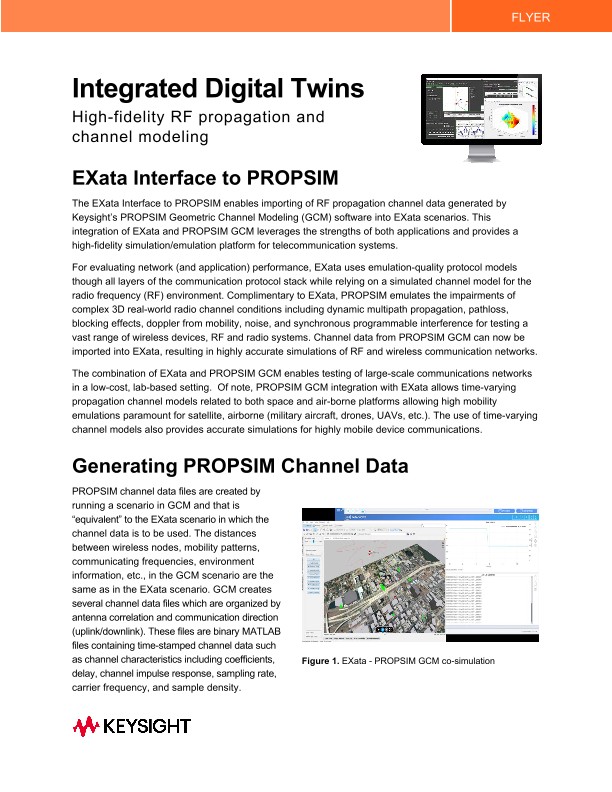
PROPSIM channel data files are created by running a scenario in GCM and that is “equivalent” to the EXata scenario in which the channel data is to be used. The distances between wireless nodes, mobility patterns, communicating frequencies, environment information, etc., in the GCM scenario are the same as in the EXata scenario. GCM creates several channel data files which are organized by antenna correlation and communication direction (uplink/downlink). These files are binary MATLAB files containing time-stamped channel data such as channel characteristics including coefficients, delay, channel impulse response, sampling rate, carrier frequency, and sample density.
Using PROPSIM channel data in EXata scenario
The channel data files generated by GCM are easily imported into an EXata scenario. The EXata scenario uses these channel data files for all EXata channel effects except propagation delays. For transmissionreceiver pairs, the EXata scenario uses the PROPSIM GCM channel data to estimate all channel effects (except propagation delay). For all other transmission-receiver pairs, EXata channel configurations are used to estimate the channel effects. The use of PROPSIM GCM simulates and emulates user-defined complex 3D radio channel conditions including multipath, pathloss, doppler, noise and interference.
By replacing EXata’s channel model of the RF environment between transmission-receiver pairs of interest with GCM channel data, unprecedented levels of end-to-end simulation accuracy can be achieved. An example is the use of GCM channel data in EXata’s 5G network simulations. EXata’s millimeter-wave pathloss model used in 5G network simulations does not account for channel fading effects such as Tap Delay Line (TDL) or Cluster Delay Line (CDL). Again, complimentary to EXata, the PROPSIM GCM channel model for 5G networks provides accurate, high-fidelity channel realizations based on the mobility and configured channel model. Since fading effect is an important factor affecting 5G signal quality, especially when the MIMO scheme is used or when the channel has high frequency selectivity, the integration of EXata and PROPSIM GCM allows the simulation of the Rx signal quality with high fidelity.
The integration of EXata and PROPSIM GCM ensures the validation of RF communications, wireless devices, and related communications networks. This integration provides a repeatable and realistic lab-based test method that provides cost-effective and seamless verification multiple designs in large-scale, technology diverse communications networks.