
Power Electronics Model Generator
技术概述
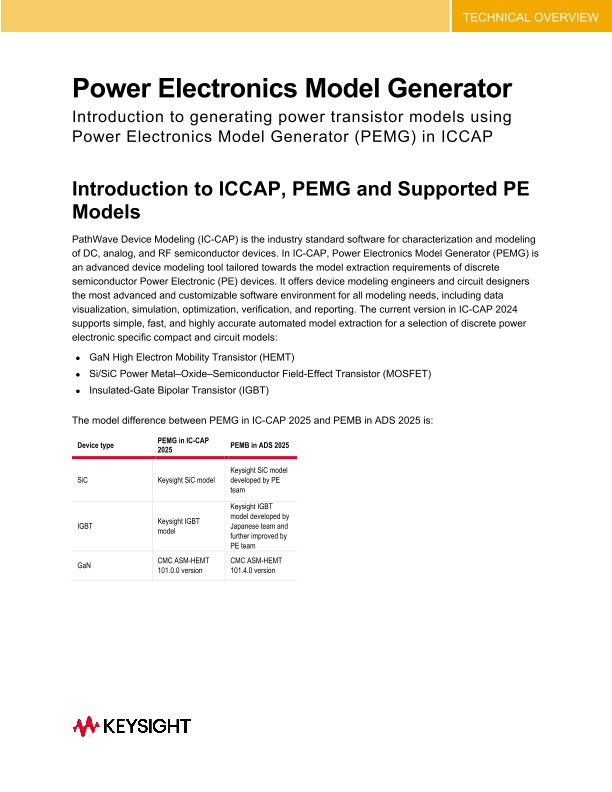
The Power Electronics Model Generator (PEMG) in IC-CAP is an advanced tool designed for automated power transistor model extraction, specifically tailored for discrete semiconductor power electronic devices such as GaN High Electron Mobility Transistors (HEMTs), Si/SiC power MOSFETs, and Insulated-Gate Bipolar Transistors (IGBTs). Offering a streamlined modeling workflow, PEMG enables device engineers and circuit designers to efficiently extract, optimize, verify, and export compact and circuit models with high accuracy. Within IC-CAP, PEMG allows users to load measured IV, CV, S-parameters, and transient data at various temperatures, apply automated parameter extraction through predefined tasks, and validate extracted models by comparing simulations with real-world measurements. The PEMG interface provides an intuitive process where users can initiate the modeling workflow by launching a power electronics example project, navigating through project settings, loading measured data, extracting parameters through automated optimization and tuning, verifying model accuracy with graphical analysis, and finally exporting netlists for further circuit and electromagnetic simulations in Keysight ADS or PSpice. The extraction process includes optimization steps where parameters are adjusted to match measured data, manual tuning for fine control, and extraction steps to define initial values and optimization ranges. With a simple one-click execution, the extraction and verification processes are fully automated, minimizing manual effort while ensuring precision in model development. The final model, complete with extracted parameters and parasitics, can be seamlessly exported for use in circuit simulation environments. A comparison between PEMG in IC-CAP and PEMB in ADS highlights key differences in supported models, with IC-CAP utilizing the Keysight SiC and IGBT models while ADS incorporates further refinements by specialized development teams. PEMG simplifies the modeling process by providing a structured environment for loading data, extracting parameters, verifying results, and generating simulation-ready netlists, making it a powerful tool for engineers working on power transistor modeling and simulation.