
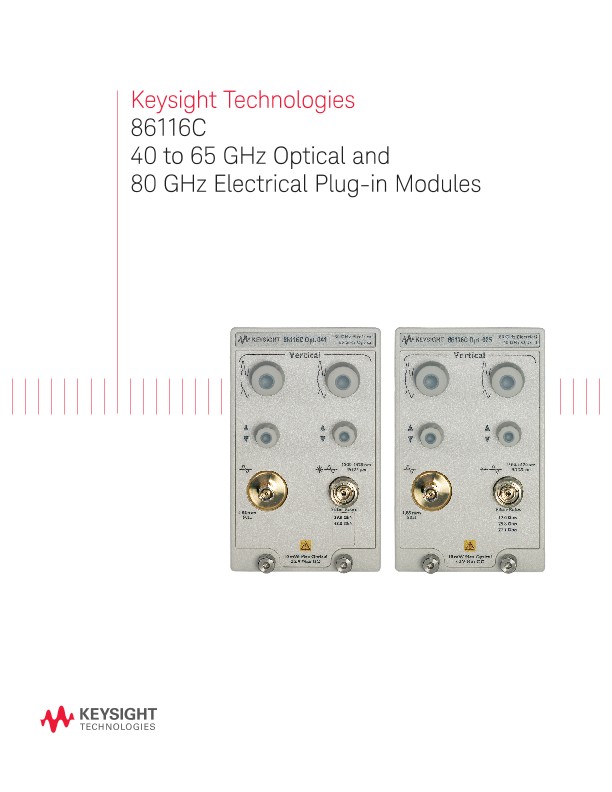
86116C 40 to 65 GHz Optical and 80 GHz Electrical Plug-in Modules
Brochures
86116C
Cutting edge component and sub-system designs require accurate characterization of very high-speed signals. When viewing waveforms in the 10 to 100 Gb/s range, three requirements are critical in an oscilloscope: a well-designed frequency response, a wide bandwidth, and extremely low internal jitter. The Keysight Technologies, Inc. 86116C optical and electrical modules represent some of the fastest solutions available for measuring high-speed communication signals. Characteristically with 45 or 70 GHz optical and 93 GHz electrical bandwidth, the 86116C when paired with the 86107A precision timebase module becomes the ideal solution for ultra high-speed waveform analysis. Designers will see the real performance of their devices and not aberrations created by the test equipment.
The unfiltered bandwidth settings provide the best pulse fidelity mode for measurement and display of very high-speed waveforms and provides
a fast full-width, half-max (FWHM) of less than 7.4 ps (86116C-041). User selectable bandwidth settings can reduce noise when observing signals. The electrical channel features over 93 GHz bandwidth. This yields a 3.9 ps system risetime. Just as important as bandwidth, the channel has a well-controlled frequency response to minimize waveform distortion. User selectable bandwidth settings can be used for reduced instrumentation noise.
The 86116C integrates with the 86100C Infiniium DCA-J wideband oscilloscope mainframe. The 86100C can hold up to two modules for a total of four measurement channels. In addition, the 86100C has a comprehensive set of waveform1 and jitter analysis2 tools that decompose the jitter components. They provide extremely valuable insights when troubleshooting or optimizing the jitter performance of a component or a system.
86116C Optical and Electrical Specifications
Specifications describe warranted performance over the temperature range +10 °C to +40 °C unless otherwise noted.Characteristics provide useful, non-warranted information about the functions and performance of the instrument. Characteristics are printed in italics.