
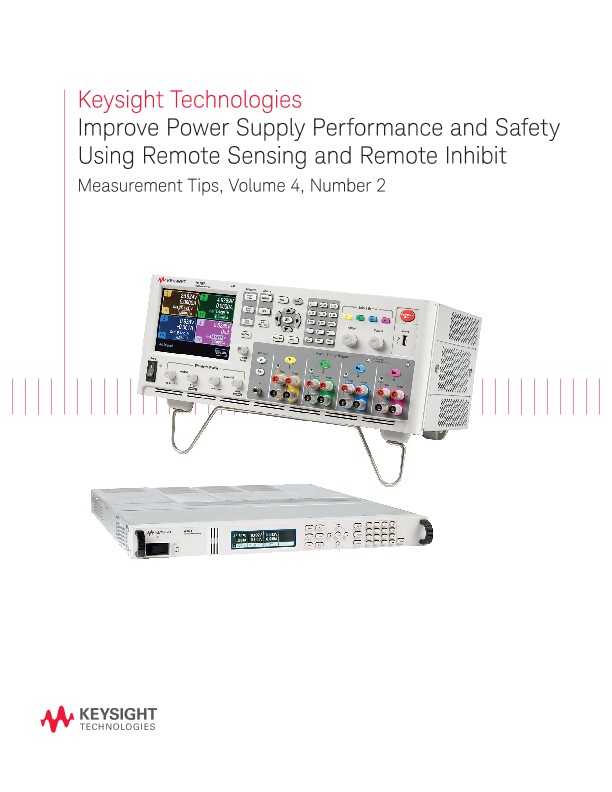
Improve Power Supply Performance and Safety Using Remote Sensing and Remote Inhibit
Brochures
When you test new designs, it is important to plan for unexpected situations – especially hazardous situations that can cause damage to the prototype, the test equipment or the person running the test. When you determine the requirements for a new test system, you anticipate what could go wrong and design a robust test that can withstand the surprises that might come up during the test and characterization of a new design. Many of today’s power products include features such as remote sensing and remote inhibit capability that make handling and reporting the unexpected situations faster and easier – helping you to minimize the risk and damage when things go wrong.
Snapshot: Testing DC-to-DC Converters
A designer of mobile handsets was testing the ability of the DC-to-DC converter inside the handset to transform the battery voltage into the controlled voltage used by the handset components. In the process of adding additional automation to the test system, the test equipment was moved further away from the DUT and connected using contacts, relays, and lengthy cabling, introducing additional resistance and inductance that made it increasingly difficult to maintain a stable voltage at the DUT. The designer used the remote sense capabilities of the Keysight Technologies, Inc. N6700 modular power system to regulate the voltage at the DUT, improving the test quality at the higher test throughput. Furthermore, the protection features of the N6700, such as over-voltage protection and remote inhibit, allowed the designer to include additional safeguards to protect the DUT and the test system, as well as the operators.
Remote sensing
Power supplies use voltage monitoring circuitry to measure the voltage at the sense terminals and a control loop to regulate the voltage at the output terminals. In the default configuration, the sense terminals are usually connected directly to the output terminals. Monitoring the voltage at the output terminals rather than at the device under test (DUT) does not compensate for the voltage drop caused by the lead resistance. The voltage at the DUT is degraded with longer leads, higher wire gauge, relays and connectors.
Using remote sensing, you can improve regulation of the voltage at the DUT. With remote sensing, you can connect the sense terminals of the power supply’s voltage monitoring circuitry directly to the DUT (see Figure 1). This allows the power supply to regulate its output voltage at the DUT, rather than at its own output terminals. The power supply adjusts the voltage as necessary to keep the voltage at the DUT constant, thereby compensating for the voltage drop caused by the resistance of load leads, relays, or connectors.
To implement remote sensing, disconnect the local sense leads from the output terminals. Some models may have a switch to select between remote and local sensing. Connect the sense lead terminals to the sense points on the DUT using twisted two-wire shielded cable. Connect one end of the shield to ground and leave the other end unconnected.
Remote inhibit (RI) is an input to a power supply that disables the output when the RI terminal is pulled low (see Figure 2). This shorts the normally open switch and turns off the power supply output. You can use the remote inhibit feature on your power supply to respond to or detect other conditions as well, such as opening a cabinet door or a fault from another device in the system.
Many power supplies also provide a discrete fault indicator (DFI) that can be used to signal an operator or other components in the system when the power supply detects the fault you defi ne. For example, to generate a DFI signal from a power supply when the DUT draws excessive current, you can program the current limit to the maximum current you expect to use. Once the over-current protection mode is enabled, you can then program the power supply to generate a DFI signal when it hits its current limit and enters constant-current mode. If the current at the DUT reaches the limit, the DFI output will go low, informing the operator of the over-current condition..
Remote inhibit
Power supplies with remote inhibit allow the power supply to shut down in response to a particular operating condition to protect system operators, the device under test, and the power supply itself. Conditions such as over-voltage, over-current and overtemperature can be detected and the power supplies configured to will shut down all power supply outputs in the system without external monitoring or programming
Summary
Remote sensing regulates the output voltage of the power supply at the DUT and offers a simple way to monitor the input voltage to the DUT. Using remote inhibit along with the discrete fault indicator allows the power supply to shut down in response to a defined operating condition and can signal the operator and the system that a fault has been detected. Using power supplies that include these features, such as Keysight’s N6700 and N6705A mainframes, can improve the performance of your test system and add additional protection for your DUT, your equipment, and your operators.