
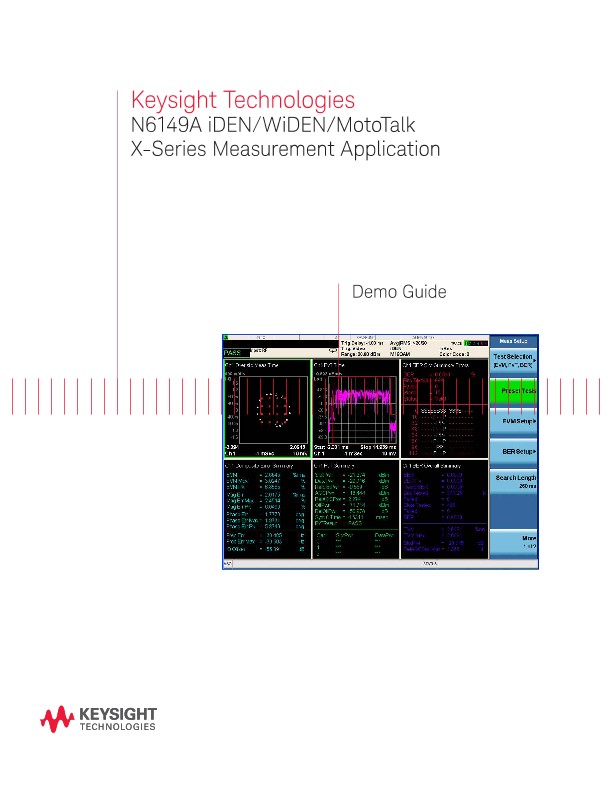
N6149A iDEN/WiDEN/MotoTalk X-Series Measurement Application
技术概述
Introduction
The N6149A iDEN/WiDEN/MotoTalk measurement application provides one-button, standard-based power and modulation analysis capabilities to help your design, evaluation, and manufacturing of iDEN radios, transmitters, amplifiers, tuners, and filters/repeaters.
Available Measurements
N6149A iDEN measurement application
- Reference power (channel power)
- ACP (adjacent channel power)
- Occupied bandwidth
- Power versus time
- Modulation analysis
- Monitor spectrum
- IQ waveform
- BER
- Slot erasure rate
- Sub channel analysis
Demonstration Preparation
All demonstrations use an X-Series signal analyzer (PXA, MXA, or EXA) with an E4438C ESG vector signal generator (or MXG) with iDEN waveforms. Keystrokes surrounded by [ ] indicate front-panel keys, while key names surrounded by { } indicate soft keys located on the right edge of the display.
To configure these instruments, connect the ESG’s 50 ‑ RF output to the X-Series signal analyzer’s 50 – RF input with a 50 ‑ RF cable. Turn on the power in both instruments. Now set up the Keysight Technologies, Inc. ESG (or MXG) to generate an iDEN signal.
Demonstration 1:
Set up an iDEN signal for analysis
Configure the ESG or as hardware connected via GPIB or LAN (TCP/IP). Follow the generator’s instructions to connect the ESG or MXG.
For this example, we will use a LAN connection to the ESG and PC; connected to a LAN port on the same server.
Demonstration 2:
Spectrum views
Swept spectrum views In the spectrum analyzer screen, select [Mode Preset] {Auto Tune}. If the RF power of the signal is below –40 dBm, you will need to manually tune the analyzer. You should see the iDEN signal in the spectrum analyzer swept SA screen.
iDEN/WiDEN measurement information
iDEN consists of several slot formats, in both inbound and outbound directions, but uses only one carrier. WiDEN has only one inbound and one outbound slot format, but has multiple carrier configurations. iDEN and WiDEN are supported in the same measurement. WiDEN support does not include auto carrier determination.
Demonstration 3:
iDEN power measurement mode
iDEN power
This measurement is intended to provide both factory test capability, and more in-depth analysis capability. The modulation formats supported by this measurement are:
- iDEN – single carrier TDMA, with multiple slot formats
- WiDEN – multiple carrier TDMA, with multiple carrier formats
iDEN power measurement mode
The factory tests supported by this measurement provide PASS or FAIL results for standard test setups. Each test also has a summary result trace and there is a common summary result trace for the two tests. Tests on both inbound and outbound formats are supported with some exceptions. Each test may be individually enabled or disabled. The provided tests are:
Occupied Bandwidth (OBW)
To utilize the limited resource of radio frequency bands to provide as many communication channels as possible, it is critical to measure and control the occupied bandwidth transmitted from a mobile phone.
The occupied bandwidth is defined as the frequency bandwidth in which 99% of the total power is measured. The occupied bandwidth of a mobile phone tends to be improved if its adjacent channel power is reduced. To provide as many channels as possible to meet the increasing number of subscribers, both of these characteristics of a mobile phone need to be measured and analyzed for further performance improvement.
Adjacent Channel Power (ACP)
To maintain a quality call by avoiding channel interference, it is important to measure and reduce the adjacent channel leakage power transmitted from a mobile phone.
The characteristics of adjacent channel leakage power are mainly determined by the transmitter design, particularly the low-pass filter. Adjacent channel leakage power is defined by the iDEN standard as the total power within the bandwidth of 10 kHz, centered at 25 kHz offset from the carrier frequency.
This adjacent channel power ratio measurement can reveal degraded or defective parts in the transmitter section of the UUT. The following examples are those areas to be further checked.