
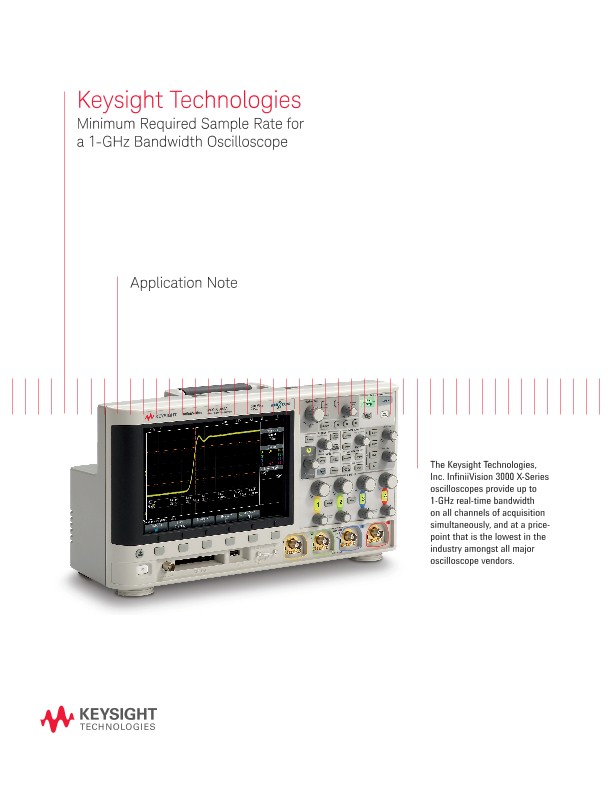
Minimum Required Sample Rate for a 1-GHz Scope
应用文章
When purchasing an oscilloscope to test new designs, the primary performance specification that most engineers consider first is the scope’s real-time bandwidth. “Real-time” simply refers to the scope’s ability to deliver the specified bandwidth on each and every acquisition cycle, or trigger event. In other words - real-time bandwidth is basically the same as single-shot bandwidth - not repetitive or equivalent-time bandwidth.
Closely related to a scope’s real-time bandwidth- and also another key consideration - is the scope’s maximum specified sample rate. Many engineers believe that higher sample rate scopes produce more accurate measurement results since more closely-spaced samples will provide increased timing resolution, and hence a more continuous waveform display. Although this is may be true for scopes that don’t have the ability to perform digital waveform reconstruction/filtering, nearly all of today’s digital storage oscilloscopes automatically perform sin(x)/x digital filtering to provide very high-density reconstructed samples based on the Nyquist sampling theorem.