
Why Migrate from the ESG to the New MXG X-Series Signal Generator?
技术概述
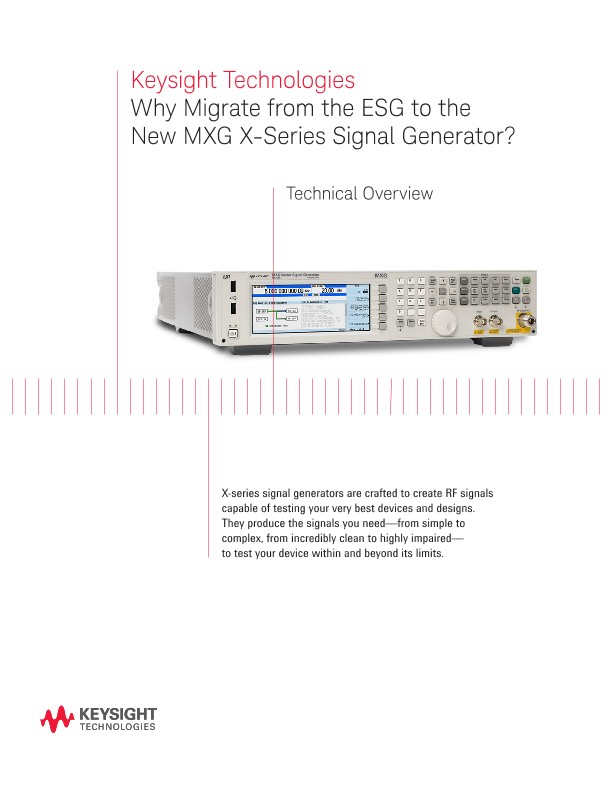
X-series signal generators are crafted to create RF signals capable of testing your very best devices and designs. They produce the signals you need—from simple to complex, from incredibly clean to highly impaired— to test your device within and beyond its limits.
Key Benefits
Generate true performance
Create signals with higher fidelity and realism. The new MXG exceeds the ESG’s performance in every category: power, ACPR, EVM, phase noise, bandwidth and memory depth.
More Applications
A wider range of signal simulation with both real-time and arbitrary waveform generation capabilities allow you to perform component and receiver test with applications that cover the latest standards.
Maximize Uptime
Enjoy the benefits of high reliability and maintainability, and a three year calibration cycle
More Compatibility
Achieve seamless migration and reduce transition risks. Extensive backward compatibility enables drop-in replacement without rewriting code or integrating new drivers.
Overview: The ESG and the New MXG X-Series Signal Generators
For many years, Keysight ESG RF signal generators have been the standard for high performance RF signal generation, widely used for component and receiver testing in both R&D and manufacturing environments. Since they were first introduced in August 1996, the ESG RF signal generators have been continually updated and enhanced, and, when used in conjunction with the Keysight Technologies, Inc. Signal Studio family of software products, support a broad range of wireless applications and formats, including GSM, WCDMA, LTE, Bluetooth®, WLAN, WiMAX™, digital video, GPS, and pulse building for radar simulation. Because transitioning to a new high-performance RF signal generator requires careful consideration, this document was created to provide an overview of the new Keysight N5181B and N5182B MXG RF signal generators and a comparison with the existing ESG sources (E4428C and E4438C).
While the ESG signal generators will continue to offer high performance signal generation and application versatility for years to come, new technologies and measurement demands will require even higher levels of performance in areas such as output power, phase noise, signal bandwidth and measurement speed. New measurement applications will require greater capabilities for very large waveform files and real-time vector signal generation. Also, many users prefer the latest instrument connectivity interfaces such as USB 2.0 or Gigabit LAN. If you foresee the need for these greater capabilities, then now is the time for you to make the transition from the ESG to the new MXG.