
Power Semiconductor Device Temperature Characterization with Keysight U5855A and B1506A
技术概述
Keysight Technologies
Power Semiconductor Device Temperature Characterization with Keysight U5855A and B1506A
Technical Overview
Introduction
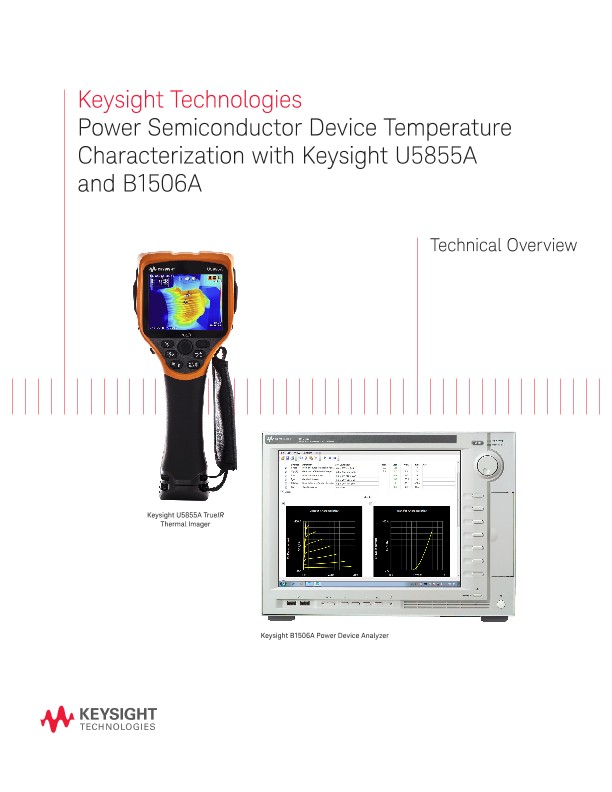
Keysight Technologies, Inc. U5855A TrueIR Thermal Imager is an ergonomically designed, easy-to-use handheld infrared thermal imager. As well as being inexpensive, the U5855A delivers 320 x 240 pixels high resolution through fine resolution capability. The U5855A is capable of focusing on objects as close as 10 cm away, demonstrating outstanding performance in thermal characterization of small components as well as predictive maintenance on electrical systems.
Keysight B1506A Power Device Analyzer is superior in evaluating parameters of all power devices including insulated gate bipolar transistors (IGBTs). The B1506A has a wide range of capabilities that help it identify substandard devices under real operating conditions, including a wide voltage and current operating range (3 kV and 1500 A), a wide thermal test capability (-50 to +250 °C), advanced Source Monitor Unit (SMU) technology and sub-nA level current measurements capability.
The power semiconductor market has been experiencing rapid growth in recent years in the fields of power electric equipment, industrial equipment, automobiles and home appliances. Impervious to high voltage, high current and high power consumption, power devices are required to be highly reliable and to operate under harsh environmental conditions. The B1506A allows easy characterization of temperature dependency which can cause a device failure.
This application note describes a measurement method using the U5855A to evaluate temperature characterization of commercially available discrete power MOSFETs and IGBT modules, in tandem with electrical characterization with the B1506A.
Temperature Characterization of Discrete Power MOSFETs
B1506A’s unique plug-in style device test fixture socket adapter is used to determine electrical characteristics of a 3-pin inline discrete power MOSFET, as shown in Figure 1, while the U5855A is used for non-contact temperature measurement of the device surface.
A relationship between power applied to the device with no heatsink and temperature changes caused by self-heating of the device is measured. The measurement procedure starts with applying a set voltage, current, and timing waveforms to the B1506A to lower power Pd that is consumed in the device (Pd = 0.5 W), causing the surface temperature of the device (case temperature) to rise and become stabilized after a while. Then, the temperature, Tc, is measured with the U5855A.
The next step is to stop voltage/current force and application of timing waveforms to the device. Make sure that the device is lowered to the ambient temperature, and reapply them to the device to increase power Pd to 0.75 W. The surface temperature of the device, Tc, is measured once it becomes stabilized.
The relationship between applied power Pd and device surface temperature Tc was measured through repeated procedures. The following shows the observed relationship in the form of “infrared thermal image” and “temperature data.”
The data sheet for the device contains an absolute rating of the junction temperature, Tj(max), and the device was rated at 150 °C. Thermal resistance between the junction and device surface, Rth(j-c), is also in the data sheet, and the device had 0.12 °C/W. The data sheet, however, contains no data on thermal resistance between the junction and ambient temperature, Rth(j-a). Thermal resistance between the device surface and ambient temperature, Rth(c-a), can be derived from a measurement result of “the relationship between device surface temperature Tc and applied power Pd” shown above.