
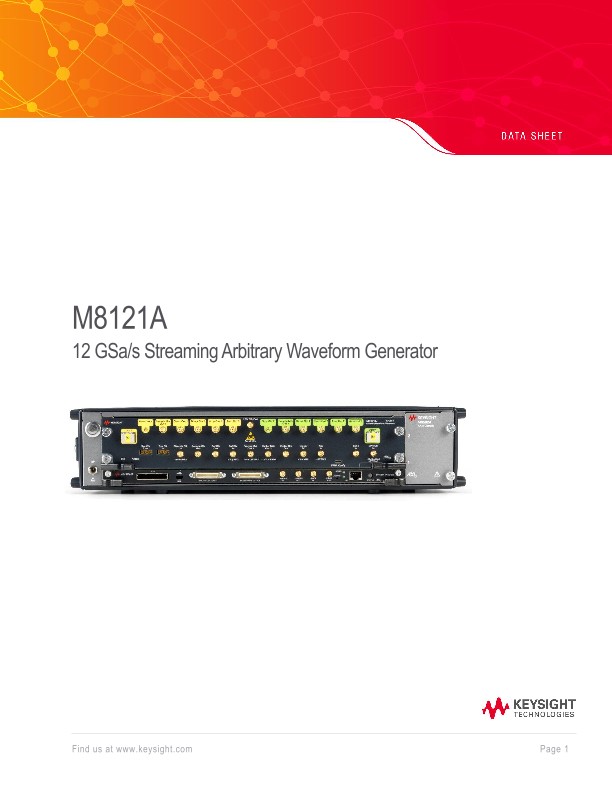
M8121A 12 GSa/s Streaming Arbitrary Waveform Generator
技术资料
M8121A
12 GSa/s Streaming Arbitrary Waveform Generator
M8121A at a glance
Key features
- 1 or 2 channel AWG module with
- 14-bit resolution up to 8 GSa/s
- 12-bit resolution up to 12 GSa/s
- Variable sample rate from 1 GSa/s to 8 or 12 GSa/s
- Analog bandwidth up to 5 GHz
- Spurious-free-dynamic range (SFDR) up to -90 dBc typical
- Harmonic distortion (HD) up to -72 dBc typical
- Internal broadband clock synthesizer with optional low-phase-noise clock input
- Optional real-time digital signal processing in Keysight Technologies, Inc. proprietary ASIC for digital up-conversion to IF1
- Form-factor: 2 U AXIe module, controlled via external PC or AXIe system controller
Optical data interface
- 2 x 160 Gb/s optical streaming interface
- Supports full rate, gapless streaming of samples into the M8121A from compatible storage, digital signal processing (DSP) or digitizer devices or custom hardware
- Synchronization input for deterministic latency e.g. from a digitizer input to M8121A output
Two output paths for different applications
- Direct DAC — optimized for best SFDR & HD
- SFDR up to -90 dBc (typ), fout = 100 MHz, measured DC to 2 GHz
- Amplitude 350 mVpp ... 700 mVpp, offset –20 mV ... +20 mV
- Differential output
- Optional DC coupled amplifier
- Amplitude 500 mVpp ... 1.0 Vpp; (over-programming down to 150 mV possible)
- Output voltage window: –1.0 V … +3.3 V
- Differential output
M8192A multi-channel synchronization module
- Phase coherent synchronization of up to six M8121A modules (= 12 channels)
- One trigger input can trigger up to six M8121A modules with deterministic latency
- Skew can be adjusted with 50 fs delay resolution between any two channels
- 1U AXIe module for high port density
Scenario Generator with Infinite Playtime
Conventional AWGs have a certain amount of built-in waveform memory that allows the user to generate pre-calculated waveform segment(s) under the control of a sequencer. But no matter how large the memory of an instrument is, it is a finite resource and eventually a loop will occur. Even the most complex sequencing engine does not eliminate this basic limitation. The M8121A uses a different approach: Instead of a built-in memory, it offers a full rate optical data interface (ODI) to supply the samples to the DAC at up to 12 GSa/s via streaming, which enables infinitely long scenarios to be generated with up to approximately 5 GHz of modulation bandwidth. The figure below shows an overview block diagram on the M8121A.
High resolution, wide bandwidth and streaming combined
The M8121A not only offers a wide bandwidth streaming interface for infinite playtime, but with up to 14 bits of vertical resolution and up to -90 dBc of spur-free dynamic range (SFDR), the M8121A achieves optimal signal performance, which is a key requirement in many aerospace defense, wireless and high-end physics applications.
Flexibility
In addition to a “direct mode”, where DAC samples are transmitted over the streaming interface, it is possible to use the built-in “digital up-conversion” functionality.1 In this mode, in-phase and quadrature (I/Q) baseband samples are supplied over the streaming interface. The signal is interpolated to the DAC sample rate, multiplied with the desired carrier frequency before it is sent to the DAC.
The benefits of this mode are:
- Lower data throughput over the streaming interface, which translates into longer playtime for a given amount of storage
- Flexibility of adjusting the waveform parameters (frequency, amplitude, phase) on the fly
- Extremely fine carrier frequency/phase resolution (down to nHz resp. 0.001 degrees)
- Absolutely no distortions like LO feed-through and images that occur with analog I/Q modulators