
Intelligent Distribution and Control of Mobile Network Traffic
技术资料
4G LTE promises to revolutionize the use of data services for mobile users worldwide. With mobile data traffic projected to grow exponentially during the coming years, mobile carriers are increasingly focused on ways to improve network service dependability and their customer’s Quality of Experience (QoE). Ultimately this effort will lead to higher levels of service assurance and increased revenue for mobile carriers. An important element in this process is the use of sophisticated and costly network monitoring probes that allow mobile carriers to immediately detect and resolve issues that impact QoE.
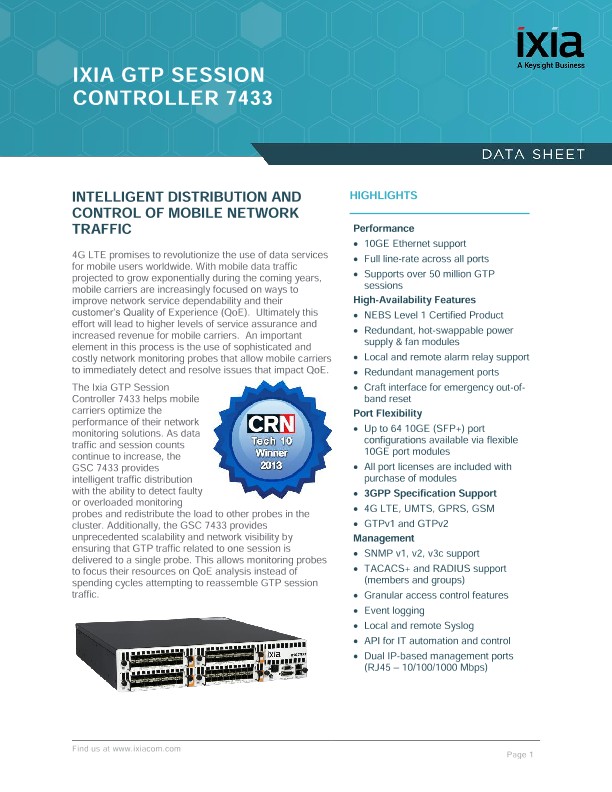
The Ixia GTP Session Controller 7433 helps mobile carriers optimize the performance of their network monitoring solutions. As data traffic and session counts continue to increase, the GSC 7433 provides intelligent traffic distribution with the ability to detect faulty or overloaded monitoring probes and redistribute the load to other probes in the cluster. Additionally, the GSC 7433 provides unprecedented scalability and network visibility by ensuring that GTP traffic related to one session is delivered to a single probe. This allows monitoring probes to focus their resources on QoE analysis instead of spending cycles attempting to reassemble GTP session traffic.
By optimizing the reliability and efficiency of monitoring probes, the GSC 7433 aids mobile carriers in the delivery of user-centric mobile services allowing them to retain and grow their subscriber base, improve ARPU and minimize operational costs.
Key features:
• GTP-session aware – Enable monitoring solutions to scale by offloading the correlation of subscriber data from monitoring probes. The GSC 7433 understands the GTP protocol and can delivers all the packets from a single subscriber to a single probe.
• Session distiller – Sample GTP sessions to reduce traffic sent to probes to the essential information, maximizing probe utilization and control costs as your network scales. Edit only the sessions you are interested in – categorize by RAT, ULI, QCI, or even individual session identified by either IMSI or IMEI, either as number or as wildcards.
• Session safety net – Automatically detect probe failure and redistribute the traffic until the probe recovers.
• Scalable, high-density solution – Build a right-sized monitoring solution with enough headroom for future growth. The GSC 7433 can distribute over 27 million subscriber sessions to probes in a 32-port configuration. To double the capacity to more than 54 million subscribers, simply double the number of ports to 64 in the same 2RU chassis.
• Carrier-grade robustness – Deliver uninterrupted traffic distribution in demanding telecommunication environments. The NEBS Level 1 certified GSC 7433 includes highavailability features such as redundant management ports, power supplies, and fan trays.
• Simple visual management – Focus on the business of running the network rather than spending time reading an instruction manual. The GSC 7433 includes a simple selfconfiguring user interface and presents function-specific statistics for insight into how the system is working.
• Remote probing – forward monitored traffic over EPC to remote monitoring probes using GRE encapsulation. Reduce traffic by trimming packets to a specific size, while optionally keeping packet length and packet ingress timestamp as metadata.
• Backup / restore – optional appliance available to keep session correlation data and tunnel identifiers during maintenance.