
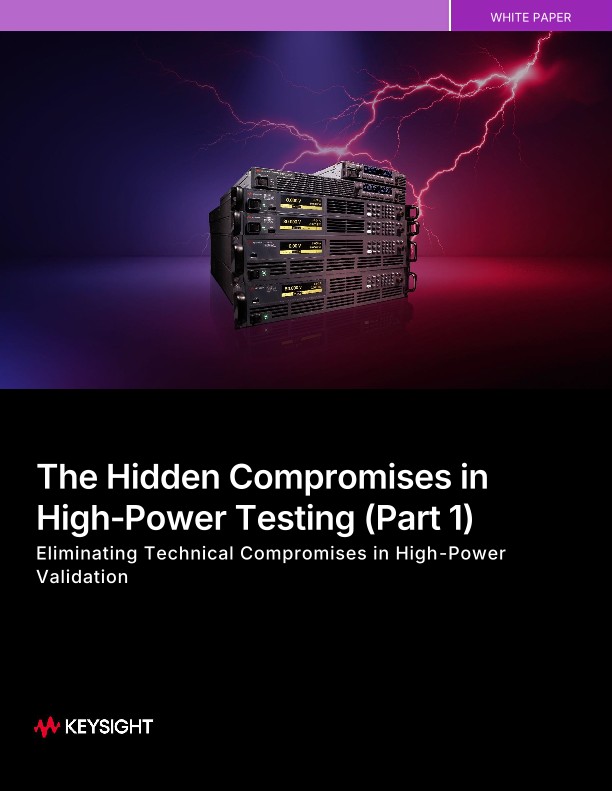
The Hidden Compromises in High‑Power Testing (Part 1)
白皮书
High-power testing has become the backbone of innovation across industries like aerospace and defense, data centers, energy storage, and next-generation automotive and electrification. Engineers must validate increasingly complex devices such as satellite payloads, electric vehicle batteries, server power supply units, and grid-scale storage systems—all of which depend on accurate, scalable, and efficient test environments. Yet despite the critical nature of these programs, many test labs still face hidden compromises that undermine performance, reliability, and safety.
This white paper, The Hidden Compromises in High-Power Testing – Part 1, examines the first three trade-offs that engineers encounter when designing and executing high-power test campaigns: accuracy versus speed, safety versus scalability, and cost versus fidelity. Each compromise reflects a fundamental tension between what the test requires and what traditional test infrastructure can deliver. By unpacking the root causes and technical realities behind these trade-offs, this paper provides engineers with a clear understanding of why they occur, how they manifest in the lab, and what strategies can be used to overcome them.
The first compromise, accuracy versus speed, highlights one of the most pressing challenges in power validation. Engineers must capture both long-term energy metrics—such as efficiency and net energy—and short-duration transients like inrush current, switching spikes, or regenerative events. Traditional test instruments often force teams to choose: run fast tests at the risk of missing critical anomalies, or slow down dramatically to preserve measurement fidelity. This paper explores how modern power supplies, electronic loads, and automated software can eliminate that trade-off by separating energy and transient domains, aligning them with synchronized triggers, and ensuring that test speed no longer comes at the cost of accuracy.
The second compromise, safety versus scalability, reflects the growing demand for higher power levels and multi-channel test setups. As power density rises, so do risks—thermal runaway, arc faults, and human error from manual cabling. At the same time, scaling test systems too conservatively reduces throughput and drives up facility costs. This section of the paper shows how layered protection strategies, regenerative architectures, automated switching, and standardized fixtures can allow organizations to multiply test capacity while maintaining strict safety margins. By engineering safety into the platform rather than relying on restrictive procedures, teams can accelerate verification without exposing personnel or equipment to unnecessary risk.
The third compromise, cost versus fidelity, focuses on the tension between budget constraints and the need for trustworthy, high-resolution data. High-accuracy instrumentation and deep data logging provide confidence, but at significant cost in capital expenditure, storage, and engineering hours. Cutting corners, however, often leads to missed edge cases, late-stage rework, and higher long-term costs. This paper outlines methods such as tiered metrology, trigger-based data capture, regenerative source/sink hardware, and deterministic automation to achieve the fidelity required for mission-critical validation while keeping both capital and operational expenses under control.
By addressing these first three compromises in detail, The Hidden Compromises in High-Power Testing – Part 1 equips engineers, test managers, and decision-makers with a technical and strategic framework to modernize their validation programs. The content emphasizes power supplies, automated test equipment (ATE) platforms, regenerative electronic loads, and automation software—technologies that are transforming how high-power testing is approached across industries.
Readers will walk away with a clear understanding of why these trade-offs exist, what risks they introduce, and how new approaches eliminate them. Instead of accepting compromises as inevitable, organizations can adopt modern test architectures that deliver accurate, safe, cost-effective, and scalable validation. In doing so, they not only meet today’s requirements but also future-proof their labs for the evolving demands of electrification, grid modernization, and digital transformation.
This paper is the first in a two-part series. Part 2 continues the discussion with two additional compromises—time-to-market versus thoroughness, and data integrity versus flexibility—to provide a complete view of how modern high-power test solutions eliminate the hidden inefficiencies that have long hindered engineers and organizations worldwide.