


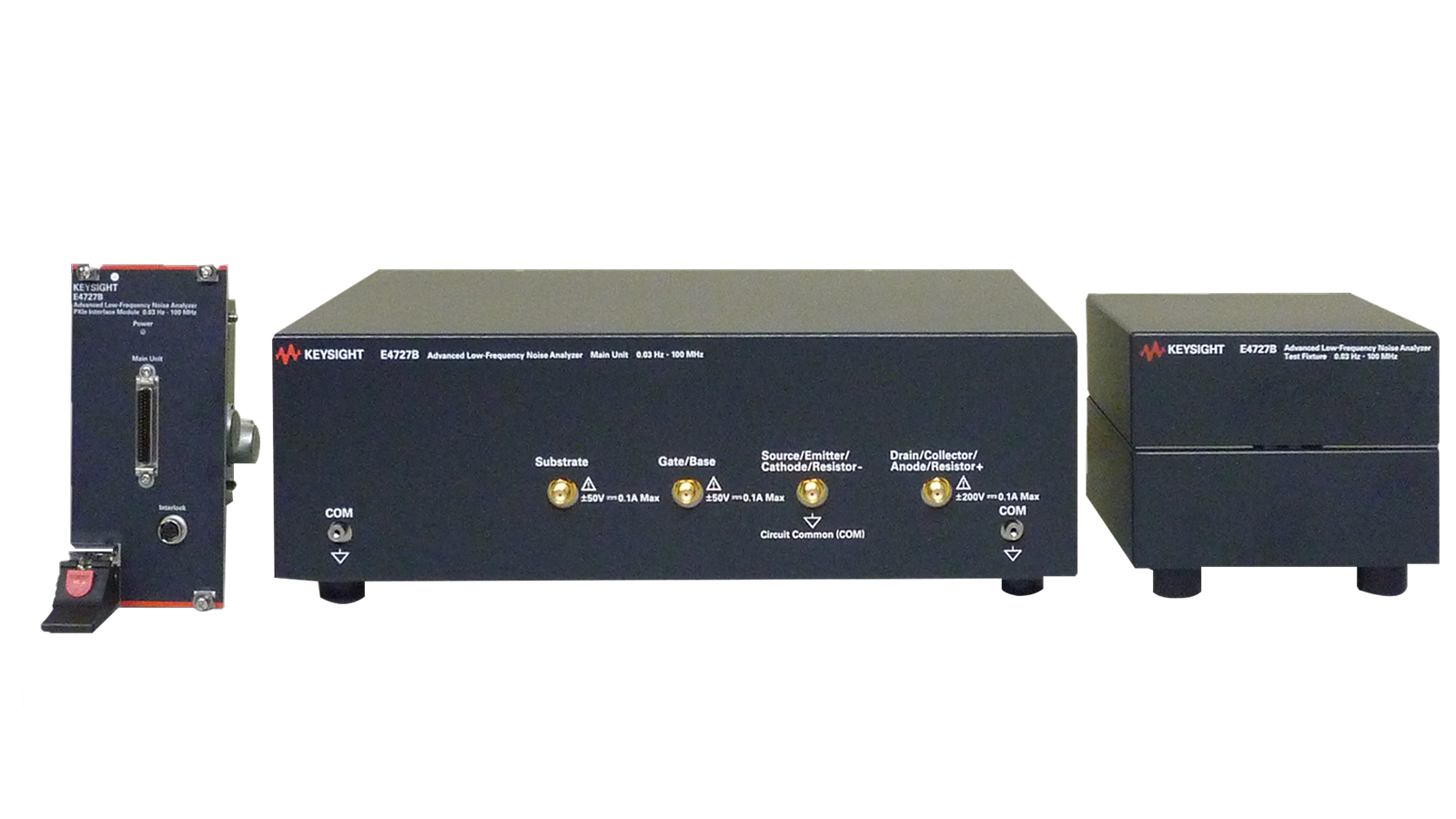
Why Use Advanced Low-Frequency Noise Analyzer (A-LFNA)
Turn critical noise data into better models and more reliable designs.
Low-frequency flicker noise and random telegraph noise (RTN) increasingly impact advanced analog, RF, and power semiconductor technologies. Keysight A-LFNA helps engineers gain deeper insight into device behavior through highly sensitive and repeatable noise characterization, enabling more accurate model development and technology qualification.
Integrated with WaferPro, A-LFNA extends automated characterization workflows beyond DC, CV, and RF measurements to include low-frequency noise analysis within a single platform. This unified approach improves measurement consistency, reduces manual effort, and accelerates the delivery of high-quality data for PDK development, model generation, and process qualification.
Key Capabilities

Advanced low-frequency noise analyzer’s integration with Device Modeling WaferPro enables turnkey noise measurements as well as the measurement of DC characteristics, capacitance, and RF S-parameters.

Extremely low device noise measurement such as transistor linear region noise by newly designed LNA.

State-of-the-art new LNA also allows noise measurement in very low bias current.

High-power device noise measurement even in a high current like 1A.

Improve measurement productivity by fast measurement speed even in the high accurate conditions with several averaging.

The software module measures DC characteristics, 1/f noise, and random telegraph noise and conducts data analysis.

Keysight’s close collaboration with FormFactor enables a complete integrated on-wafer solution with automated control of all major wafer probing systems.
Turnkey Measurements
The A-LFNA’s built-in measurement routines make DC and noise measurements turnkey. For example, to measure noise on an N-Type MOSFET, the system automatically chooses the source and load impedances that will best expose the intrinsic device noise. The engineer can accept these recommended settings or make changes, and a noise measurement is initiated. The A-LFNA then measures noise power spectral density (1/f noise) and noise in the time domain (RTN). The resulting data is plotted using a multiplot data display window. Various windows' tabs help facilitate common tasks such as evaluating the device's DC operating point and measuring the slope of the power spectral density curve. Noise data can also be analyzed and represented in device models using device modeling tools such as Device Modeling (MBP) and Device Modeling (IC-CAP). Circuit designers can use these device models to ensure highly accurate RF and analog low-noise circuit design.

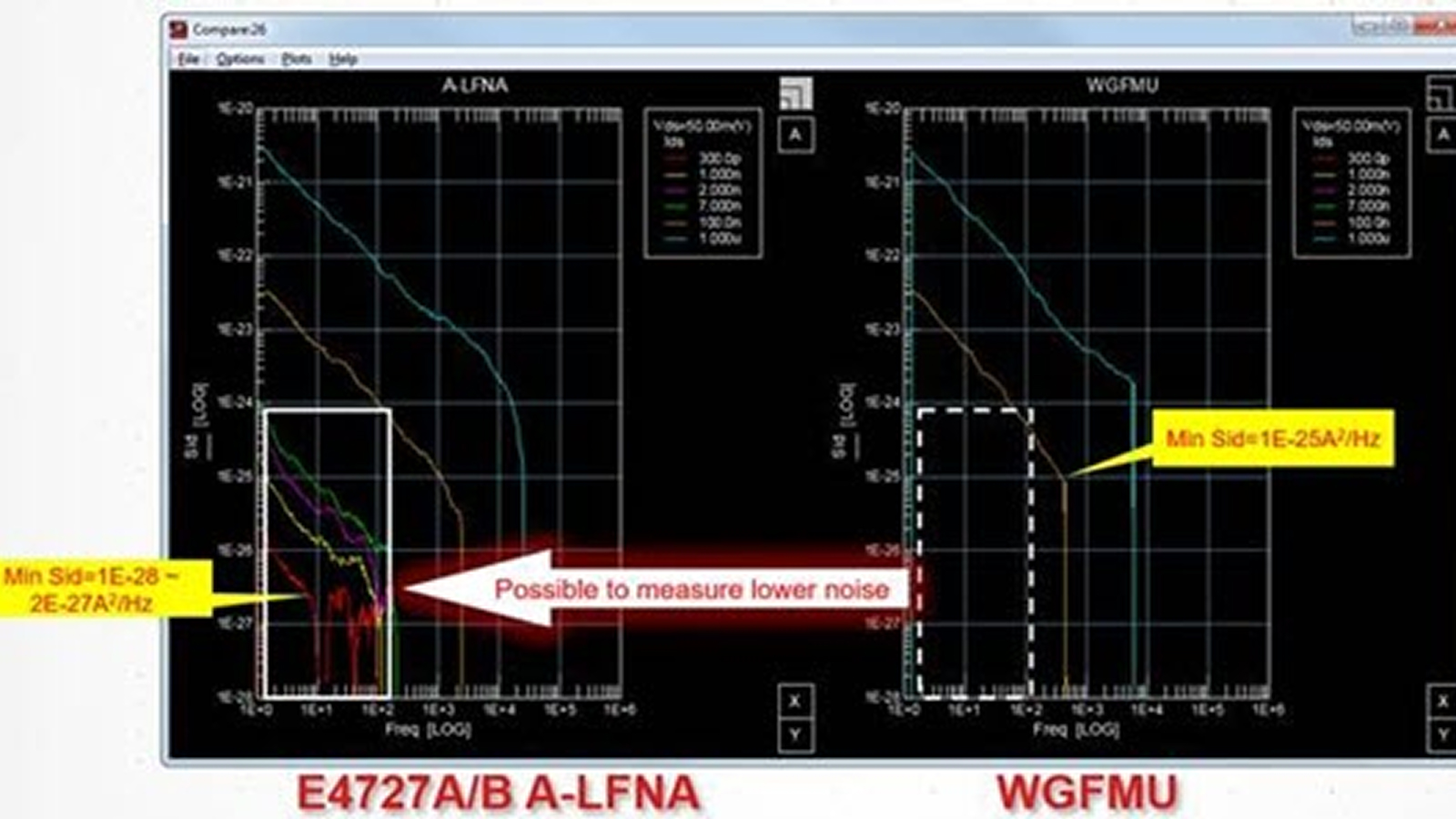


Automated RTN Solution Using W7801B and B1500A
W7801B (Device Modeling WaferPro WGFMU Measurement bundle) efficiently performs at a low cost and automated RTN measurement on the wafer using the B1500A Semiconductor Device Analyzer with the B1530A Waveform Generator/Fast Measurement Unit (WGFMU). It can improve the efficiency of RTN measurement and data analysis including wafer prober control.
Key features
- Automated measurement without programming
- Auto prober control
- Wafer mapping
- Single data display for multi-decade in frequency domain
- Upgradeable from your existing B1500A
Resources to Get You Started
The ability to perform current or voltage measurement at any point along a voltage pulse or arbitrarily generated voltage waveform has long been a highly desired measurement capability.

Webinars

散页
E4727B Advanced Low-Frequency Noise Analyzer

Case Studies
Determined the Low-Frequency Noise Source in Cryogenic Operation
应用文章
LF Noise Measurement of D/A Converter
应用文章
Really Need Both Current-LNA and Voltage-LNA to Measure LF Noise?
应用文章
Enabling Noise Measurements on Magnetic Sensors
Brochures
Global Device Modeling Services
Have Questions? We've Got Answers
The Keysight E4727B Advanced Low-Frequency Noise Analyzer is a turnkey solution for fast, accurate, and repeatable low-frequency noise measurements. It characterizes flicker (1/f) noise and random telegraph noise (RTN) in semiconductor devices, supporting advanced device modeling and reliability analysis.
The E4727B measures DC characteristics, 1/f noise, and random telegraph noise while providing integrated data analysis capabilities. It also supports automated wafer-level testing and can be combined with capacitance and RF measurements.
The analyzer provides industry-leading sensitivity for detecting extremely low noise levels across a wide range of device types. This helps engineers develop accurate device models and identify performance-limiting noise mechanisms earlier.
Yes. Integration with Keysight WaferPro Express enables automated wafer probing, wafer mapping, and test sequencing. Engineers can efficiently collect large volumes of low-frequency noise data across entire wafers.
The E4727B supports process design kit (PDK) development, IC noise specification, manufacturing process control, reliability studies, and semiconductor device modeling for low-noise electronic designs.