您希望搜索哪方面的内容?
RSoft GratingMOD CMT
CMT simulation tool for complicated fiber and integrated waveguide grating devices

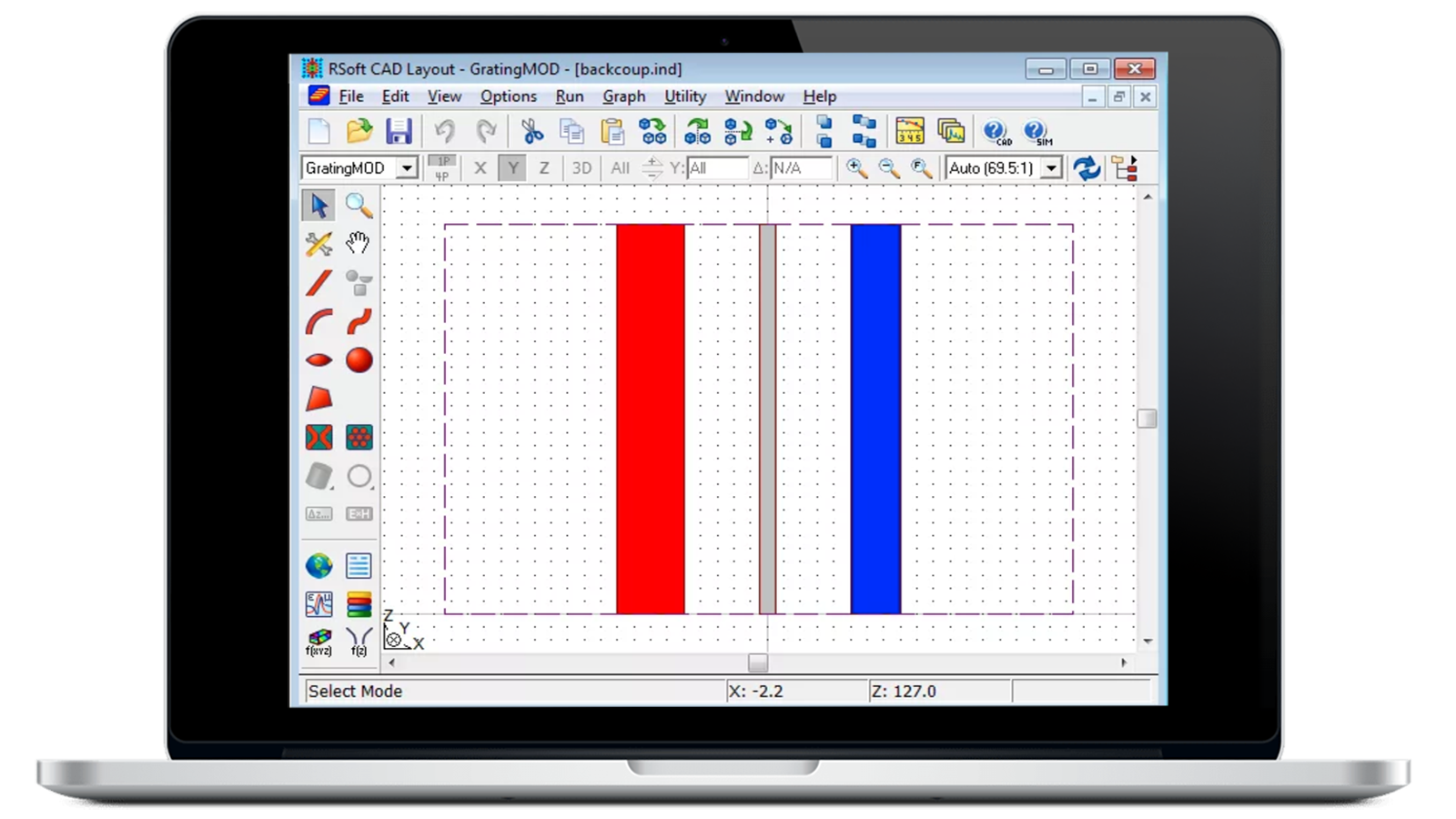
Rapidly Simulate Fiber and Waveguide Grating Devices
Optimize the performance of your photonic applications with RSoft GratingMOD CMT, a general design tool that rapidly simulates complicated grating profiles in optical fibers and integrated waveguide circuits. GratingMOD efficiently powers CMT or coupled mode theory analysis. Use the GratingMOD CMT simulation tool to streamline analysis of known grating structures as well as the synthesis of grating structures from desired or measured spectra.
- Conduct fast and accurate simulations with sophisticated multiple mode algorithms for advanced applications.
- Apply GratingMOD as a general CMT simulation platform to various coupling mechanisms.
Key Features of RSoft GratingMOD CMT


Bragg condition searching
Find both the period from the specified modes and the modes from a specified period (in other words, angle and wavelength) for Bragg condition analysis.


Coupled structure analysis
Study an arbitrary number of gratings at arbitrary positions in 2D and 3D structures including fiber core coupling, side coupling for integrated circuits, and more.


RSoft CAD integration
Fully integrated in the RSoft CAD Environment, GratingMOD works seamlessly with RSoft’s other passive device simulation tools.


Advanced CMT implementation
With the GratingMOD CMT simulation tool, analyze multi-mode grating systems from transmitted and reflected spectra, then synthesize them to solve the inverse problem.


Comprehensive calculations
Calculate phase, dispersion, time delay, and bandwidth for primary order reflection. Generate mode, apodization, chirp, and grating profiles.
Need Support for RSoft GratingMOD CMT?
Explore Blogs






Featured Resources





RSoft GratingMOD CMT Simulation Tool – FAQ
GratingMOD is a general design tool that analyzes and synthesizes complicated fiber and integrated waveguide grating devices.
GratingMOD has applications across integrated and fiber-optic devices such as:
- Dispersion compensation fiber Bragg grating
- Multiplexing/demultiplexing
- Add/drop filtering
- Gain equalization in optical amplifiers
- Grating-assisted couplers
- Long-period grating sensors
Fully integrated in the RSoft CAD Environment, the GratingMOD CMT simulation tool can examine known grating structures and synthesize the grating structures from desired or measured spectra using an augmented layer-peeling technique. In conjunction with RSoft BeamPROP, GratingMOD’s coupled mode theory analysis capabilities can accommodate any type of waveguide or fiber transverse profile.
The GratingMOD mode solver can handle slab and fiber structures as well as waveguides with arbitrary cross-sections. Leverage predefined and user-defined chirp and apodization features for longitudinal grating structures, and extensive post-processing for spectrum analysis. Modify the input spectrum to create a realizable spectrum.